Skip to main content
Analytical Chemistry
My Course
Learn
Exam Prep
AI Tutor
Study Guides
Flashcards
Explore
Try the app
My Course
Learn
Exam Prep
AI Tutor
Study Guides
Flashcards
Explore
Try the app
Back
PUblic flashcard
1 student found this helpful
You can tap to flip the card.
What is the kilogram defined as in the SI base units?
You can tap to flip the card.
👆
What is the kilogram defined as in the SI base units?
Kilogram
is defined as the mass equal to a Pt-Ir alloy prototype constructed in 1885.
Track progress
Control buttons has been changed to "navigation" mode.
1/20
Recommended videos
Guided course
03:34
SI Units vs. Derived Units
1764
views
18
rank
Terms in this set (20)
Hide definitions
What is the kilogram defined as in the SI base units?
Kilogram
is defined as the mass equal to a Pt-Ir alloy prototype constructed in 1885.
How is the meter defined in the SI base units?
Meter
is the distance light travels in a vacuum during 3.335 x 10
-9
seconds.
What is the definition of the second in SI units?
Second
is related to an atomic transition of Cesium-133.
How is the kelvin defined in the SI system?
Kelvin
is defined by the triple point of H
2
O at 273.15 K and absolute zero at 0 K.
What does the mole represent in SI units?
Mole
is the number of particles equal to the number of atoms in 0.012 kg of Carbon-12 (~6.022 x 10
23
).
What is the ampere defined as?
Ampere
is the unit of electric current representing the flow of one coulomb per second.
What is the radian and steradian in SI units?
Radian
is a plane angle where a circle contains 2π radians;
Steradian
is a solid angle where a sphere contains 4π steradians.
What is the formula for molarity (M)?
Molarity (M)
= moles of solute / liters of solution.
What is the formula for molality (m)?
Molality (m)
= moles of solute / kilograms of solvent.
How is weight percent concentration calculated?
Weight percent
= (mass of solute / mass of solution) × 100.
How is volume percent concentration calculated?
Volume percent
= (volume of solute / volume of solution) × 100.
How is weight/volume percent concentration calculated?
Weight/volume percent
= (mass of solute in grams / volume of solution in mL) × 100.
What is the dilution equation used in analytical chemistry?
Dilution equation:
M
1
V
1
= M
2
V
2
, where M is molarity and V is volume before and after dilution.
What does the stoichiometric chart help with in titrations?
It helps convert between moles, grams, and formula units of known and unknown compounds using balanced chemical equations.
What is the balanced net ionic equation for oxidation of Fe(II) by dichromate?
Cr
2
O
7
2-
+ 6 Fe
2+
+ 14 H
+
→ 2 Cr
3+
+ 6 Fe
3+
+ 7 H
2
O
.
What is the formula to calculate molarity from ppm?
Molarity can be calculated by converting ppm to grams per liter and dividing by molar mass.
What is the relationship between molarity and molality?
Molarity depends on solution volume; molality depends on solvent mass, making molality temperature independent.
How do you calculate molar concentration of ions from percent composition?
Use percent weight, solution density, and molar mass to find moles of ions per liter.
What is the significance of the mole fraction in solution concentration?
Mole fraction represents the ratio of moles of a component to total moles in the solution.
What is the general approach to titration calculations?
Use balanced chemical equations and molarity-volume relationships to find unknown concentrations or masses.
 BackBack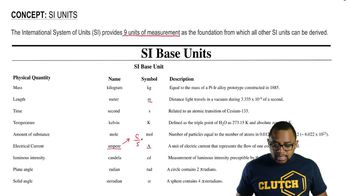
 03:34
03:34