Which level of organization consists of groups of cells with similar structures and functions? (More than one may apply.) <IMAGE>
Verified step by step guidance
1
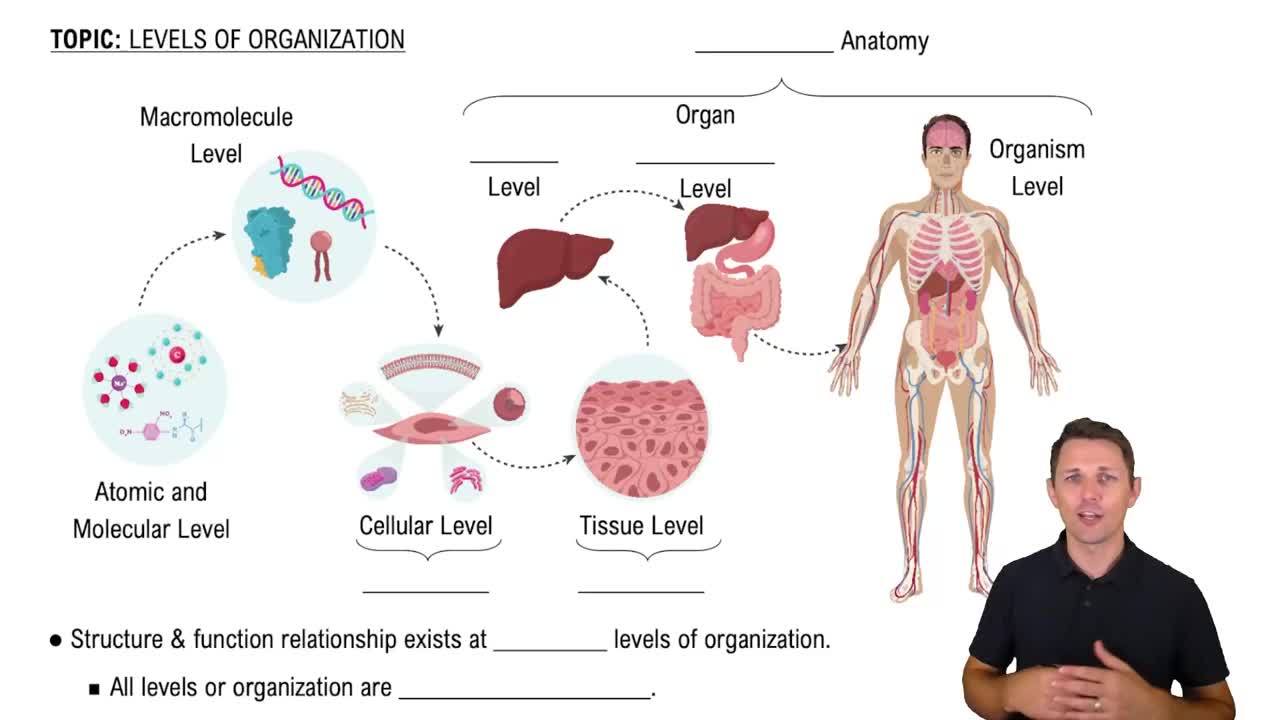
Understand the levels of biological organization in Anatomy & Physiology, which typically include: cells, tissues, organs, organ systems, and the organism as a whole.
Recall that a 'group of cells with similar structures and functions' defines the level known as 'tissue.'
Identify which options in the problem correspond to tissues by looking for descriptions or images showing collections of similar cells working together.
Eliminate options that represent single cells (cellular level) or more complex structures like organs or organ systems, as these involve multiple tissue types.
Conclude that the correct answer(s) are those labeled as tissues, since tissues are the organizational level made up of groups of similar cells performing a common function.
Verified video answer for a similar problem:
This video solution was recommended by our tutors as helpful for the problem above
Video duration:
2m
Play a video:
0 Comments
Key Concepts
Here are the essential concepts you must grasp in order to answer the question correctly.
Cellular Level of Organization
The cellular level refers to the basic unit of life, where individual cells perform specific functions. Cells with similar structures and functions group together to form tissues, which is the next organizational level.
Tissues are groups of cells that share similar structure and function, working together to perform a specific activity. Examples include muscle tissue, nervous tissue, and epithelial tissue.
Biological organization progresses from cells to tissues, organs, organ systems, and the whole organism. Understanding these levels helps identify which groupings correspond to similar cells working collectively.