
Textbook Question
The vitamins essential for normal adult bone maintenance and repair are:
(a) A and E
(b) C and D3
(c) B and E
(d) B complex and K
473
views

 Verified step by step guidance
 08:25
08:25
 6:19
6:19 2:58
2:58The vitamins essential for normal adult bone maintenance and repair are:
(a) A and E
(b) C and D3
(c) B and E
(d) B complex and K
The hormones that coordinate the storage, absorption, and excretion of calcium ions are:
(a) Growth hormone and thyroxine
(b) Calcitonin and parathyroid hormone
(c) Calcitriol and cholecalciferol
(d) Estrogens and androgens
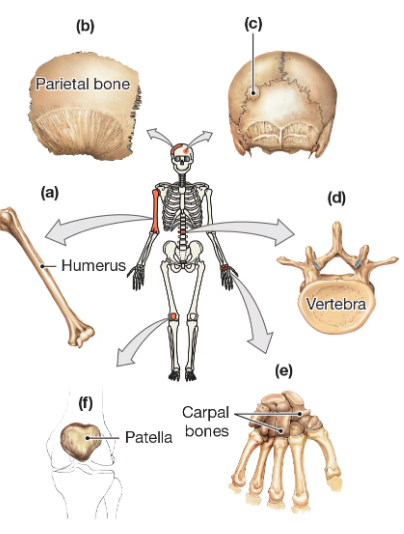
Classify the bones in the following diagram according to their shape.
e. _____
Classify the bones in the following diagram according to their shape.
d. _____
Classify the bones in the following diagram according to their shape.
c. _____
Classify the bones in the following diagram according to their shape.
a. _____