Ch. 1 The Human Body: An Orientation
Marieb - Human Anatomy & Physiology 7th Edition
Marieb, Hoehn7th EditionHuman Anatomy & PhysiologyISBN: 9780805359091Not the one you use?Change textbook
Chapter 1, Problem 14

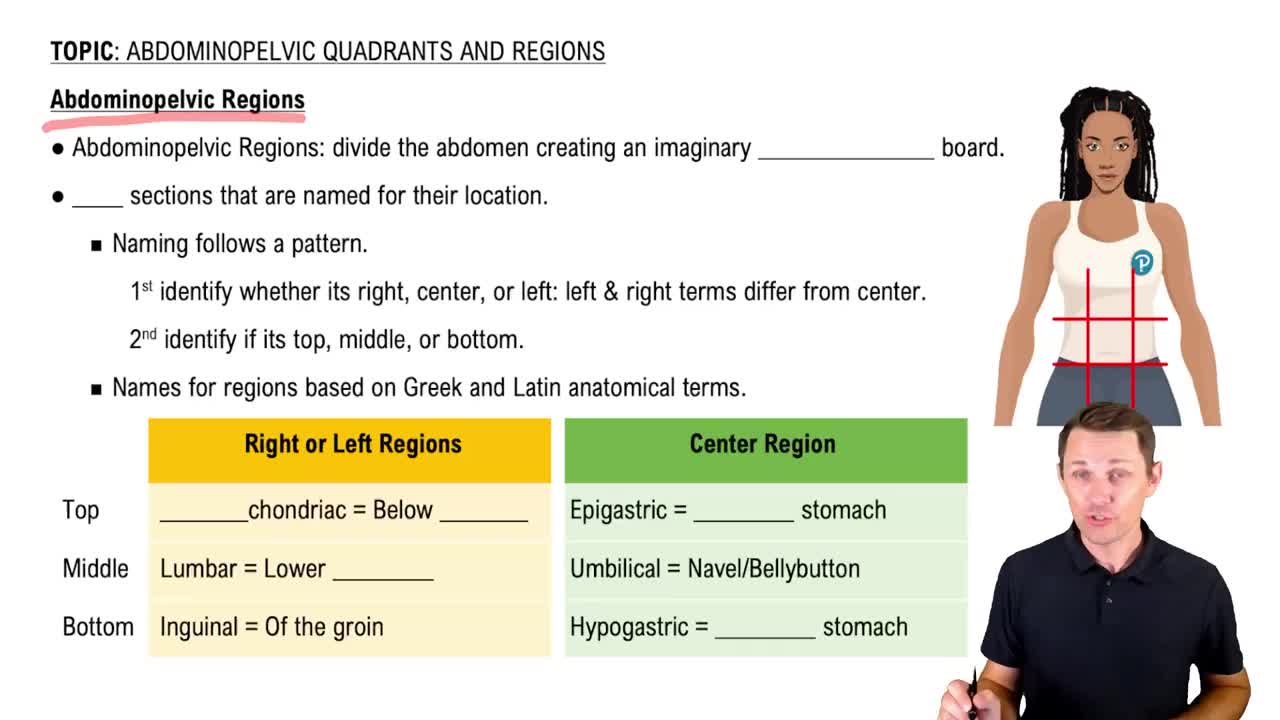
a. Make a diagram showing the nine abdominopelvic regions, and name each region. Name two organs (or parts of organs) that could be located in each of the named regions.


b. Make a similar sketch illustrating how the abdominopelvic cavity may be divided into quadrants, and name each quadrant.

Verified step by step guidance
1
Start by drawing a large rectangle to represent the abdominopelvic cavity. This will be the base for dividing the regions and quadrants.
To create the nine abdominopelvic regions, draw two vertical lines and two horizontal lines evenly spaced within the rectangle, forming a 3x3 grid. This divides the area into nine smaller rectangles.
Label each of the nine regions as follows: Top row - Right Hypochondriac, Epigastric, Left Hypochondriac; Middle row - Right Lumbar, Umbilical, Left Lumbar; Bottom row - Right Iliac (or Inguinal), Hypogastric (or Pubic), Left Iliac (or Inguinal).
For each region, identify two organs or parts of organs that are commonly found there. For example, the Right Hypochondriac region may contain the liver and gallbladder, while the Umbilical region may contain parts of the small intestine and transverse colon.
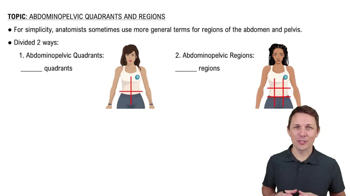
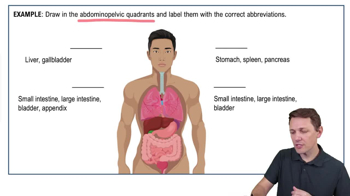
Next, to illustrate the four quadrants, draw one vertical and one horizontal line intersecting at the navel (umbilicus) on the same rectangle. Label the quadrants as Right Upper Quadrant (RUQ), Left Upper Quadrant (LUQ), Right Lower Quadrant (RLQ), and Left Lower Quadrant (LLQ).

Verified video answer for a similar problem:

This video solution was recommended by our tutors as helpful for the problem above.
Video duration:
1m
Was this helpful?

Key Concepts

Here are the essential concepts you must grasp in order to answer the question correctly.

Nine Abdominopelvic Regions

The nine abdominopelvic regions divide the abdomen into specific areas using two vertical and two horizontal imaginary lines. These regions include the right and left hypochondriac, epigastric, right and left lumbar, umbilical, right and left iliac (inguinal), and hypogastric (pubic) regions. This division helps in precisely locating organs and describing pain or abnormalities.
Recommended video:
Guided course
04:21
The 9 Abdominopelvic Regions

Abdominopelvic Quadrants

The abdominopelvic cavity is divided into four quadrants by one vertical and one horizontal line intersecting at the navel. These quadrants are the right upper quadrant (RUQ), left upper quadrant (LUQ), right lower quadrant (RLQ), and left lower quadrant (LLQ). This simpler division is commonly used in clinical settings to localize symptoms or findings.
Recommended video:
Guided course
3:47
The 4 Abdominopelvic Quadrants

Organ Localization within Regions and Quadrants

Each abdominopelvic region and quadrant contains specific organs or parts of organs. For example, the liver is mainly in the right hypochondriac region and RUQ, while the stomach lies in the epigastric region and LUQ. Understanding which organs lie in each area aids diagnosis and communication in medicine.
Recommended video:
Guided course
3:01
Abdominopelvic Quadrants and Regions Example 1