Ch. 2 Chemistry Comes Alive
Marieb - Human Anatomy & Physiology 7th Edition
Marieb, Hoehn7th EditionHuman Anatomy & PhysiologyISBN: 9780805359091Not the one you use?Change textbook
Chapter 2, Problem 4

Which of the following does not describe a mixture?
a. Properties of its components are retained
b. Chemical bonds are formed
c. Components can be separated physically
d. Includes both heterogeneous and homogeneous examples

Verified step by step guidance
1
Step 1: Understand the question is asking to identify which element is NOT one of the four major elements that contribute most to the human body's mass.
Step 2: Recall the four major elements that make up the majority of the human body mass. These are Hydrogen (H), Carbon (C), Nitrogen (N), and Oxygen (O).
Step 3: Review the options given: Hydrogen, Carbon, Nitrogen, Sodium, and Oxygen.
Step 4: Compare each option to the list of the four major elements. Hydrogen, Carbon, Nitrogen, and Oxygen are all part of the major elements.
Step 5: Identify Sodium as the element that does not belong to the four major elements contributing to body mass, as it is a minor element present in smaller amounts.

Verified video answer for a similar problem:

This video solution was recommended by our tutors as helpful for the problem above.
Video duration:
2m
Was this helpful?

Key Concepts

Here are the essential concepts you must grasp in order to answer the question correctly.

Four Major Elements of Body Mass

The human body is primarily composed of four major elements: oxygen, carbon, hydrogen, and nitrogen. These elements make up the bulk of organic molecules such as proteins, lipids, carbohydrates, and nucleic acids, which are essential for life.
Recommended video:
7:17
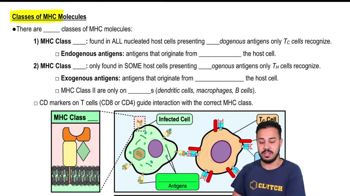
Classes of MHC Molecules

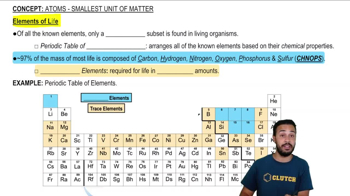
Role of Trace Elements

Trace elements like sodium, potassium, and calcium are present in smaller amounts but are vital for physiological functions such as nerve transmission and muscle contraction. However, they do not contribute significantly to overall body mass.
Recommended video:
03:36
Elements of Life

Distinguishing Major vs. Minor Elements

Understanding the difference between major elements that constitute most of the body's mass and minor or trace elements that support specific functions is key. This distinction helps identify which elements are fundamental to body composition.
Recommended video:
2:31
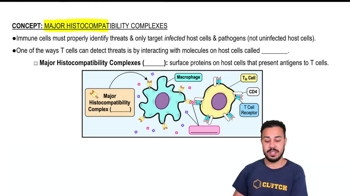
Major Histocompatibility Complexes