Ch. 7 The Skeletal System
Amerman - Human Anatomy & Physiology 2nd Edition
Amerman2nd EditionHuman Anatomy & PhysiologyISBN: 9780136873822Not the one you use?Change textbook
Chapter 7, Problem 1

Which of the following are considered parts of the axial skeleton? (Circle all that apply.)


a. Pectoral girdle
b. Lower limb
c. Skull
d. Vertebral column
e. Pelvic girdle
f. Thoracic cage

Verified step by step guidance
1
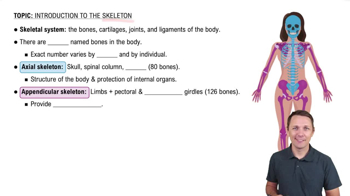
Step 1: Understand the axial skeleton. The axial skeleton consists of the bones that form the central axis of the body, including the skull, vertebral column, and thoracic cage. It provides support and protection for the brain, spinal cord, and vital organs.
Step 2: Differentiate between the axial skeleton and the appendicular skeleton. The appendicular skeleton includes the limbs and girdles (pectoral and pelvic girdles), which are responsible for movement and attachment of the limbs.
Step 3: Analyze each option provided in the question: a. Pectoral girdle (part of the appendicular skeleton), b. Lower limb (part of the appendicular skeleton), c. Skull (part of the axial skeleton), d. Vertebral column (part of the axial skeleton), e. Pelvic girdle (part of the appendicular skeleton), f. Thoracic cage (part of the axial skeleton).
Step 4: Identify the correct answers based on the definition of the axial skeleton. The parts of the axial skeleton are the skull, vertebral column, and thoracic cage.
Step 5: Conclude that the correct options are c. Skull, d. Vertebral column, and f. Thoracic cage, as these are components of the axial skeleton.

Verified video answer for a similar problem:

This video solution was recommended by our tutors as helpful for the problem above.
Was this helpful?

Key Concepts

Here are the essential concepts you must grasp in order to answer the question correctly.

Axial Skeleton

The axial skeleton is a major part of the human skeleton that consists of the bones along the body's long axis. It includes the skull, vertebral column, and thoracic cage, which protect vital organs and support the head and trunk. Understanding the components of the axial skeleton is essential for identifying which bones are included in this category.
Recommended video:
Guided course
4:50
Skeletal System

Skull

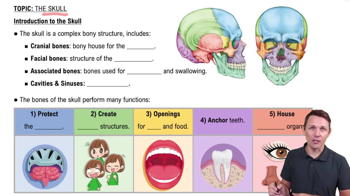
The skull is a bony structure that forms the head and houses the brain, as well as the structures of the face. It is a crucial component of the axial skeleton, providing protection for the brain and supporting the facial structure. Knowledge of the skull's anatomy is important for distinguishing it from other skeletal components.
Recommended video:
Guided course
4:42
Introduction to the Skull

Vertebral Column

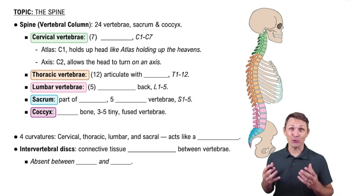
The vertebral column, or spine, is a series of vertebrae that extends from the skull to the lower back, providing structural support and protecting the spinal cord. It is a key part of the axial skeleton, allowing for flexibility and movement while maintaining stability. Understanding its role is vital for recognizing the overall function of the axial skeleton.
Recommended video:
Guided course
6:29
Spine (Vertebral Column)