What would happen if activation energy barriers didn't exist?a. Substrates would not bind properly to enzymes;b. Chemical reactions in the body would never occur;c. Enzyme function would not be affected;d, Metabolic reactions would proceed even if their products were not needed.
Verified step by step guidance
1
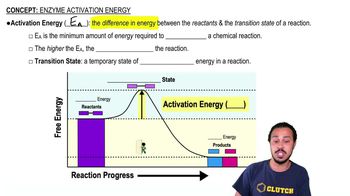
Understand the concept of activation energy: Activation energy is the minimum amount of energy required to initiate a chemical reaction. It acts as a barrier to prevent reactions from occurring spontaneously.
Consider the role of enzymes: Enzymes are biological catalysts that lower the activation energy of reactions, allowing them to proceed more quickly and efficiently.
Analyze the implications of no activation energy barriers: Without these barriers, reactions could occur spontaneously and uncontrollably, regardless of the cell's needs.
Evaluate each option: a) Substrates binding to enzymes is not directly related to activation energy barriers. b) Reactions would still occur, but potentially uncontrollably. c) Enzyme function is related to lowering activation energy, so it would be affected. d) Metabolic reactions could proceed without regulation, leading to unnecessary product formation.
Determine the most logical outcome: Consider which option best describes the scenario where reactions proceed without the need for activation energy, focusing on the regulation and necessity of reactions.
Verified video answer for a similar problem:
This video solution was recommended by our tutors as helpful for the problem above
Video duration:
1m
Play a video:
0 Comments
Key Concepts
Here are the essential concepts you must grasp in order to answer the question correctly.
Activation Energy
Activation energy is the minimum energy required for a chemical reaction to occur. It acts as a barrier that must be overcome for reactants to transform into products. Without this energy barrier, reactions could proceed spontaneously at any temperature, leading to uncontrolled and potentially harmful processes in biological systems.
Enzymes are biological catalysts that speed up chemical reactions by lowering the activation energy required. They bind to substrates to form an enzyme-substrate complex, facilitating the conversion to products. If activation energy barriers did not exist, the role of enzymes would be diminished, as reactions would occur without their assistance, potentially disrupting metabolic pathways.
Metabolic reactions are the biochemical processes that occur within living organisms to maintain life, including catabolism and anabolism. These reactions are tightly regulated to ensure that products are only formed when needed. If activation energy barriers were absent, metabolic reactions could occur indiscriminately, leading to imbalances and the production of unnecessary or harmful substances.

 1:57 minutes
 Verified step by step guidance
 04:18
04:18