List the three major categories of formed elements Which is least numerous? Which comprise(s) the buffy coat in a hematocrit tube?
Verified step by step guidance
1
Identify the three major categories of formed elements in blood: red blood cells (erythrocytes), white blood cells (leukocytes), and platelets (thrombocytes).
Understand the relative abundance of each formed element: red blood cells are the most numerous, white blood cells are the least numerous, and platelets are intermediate in number.
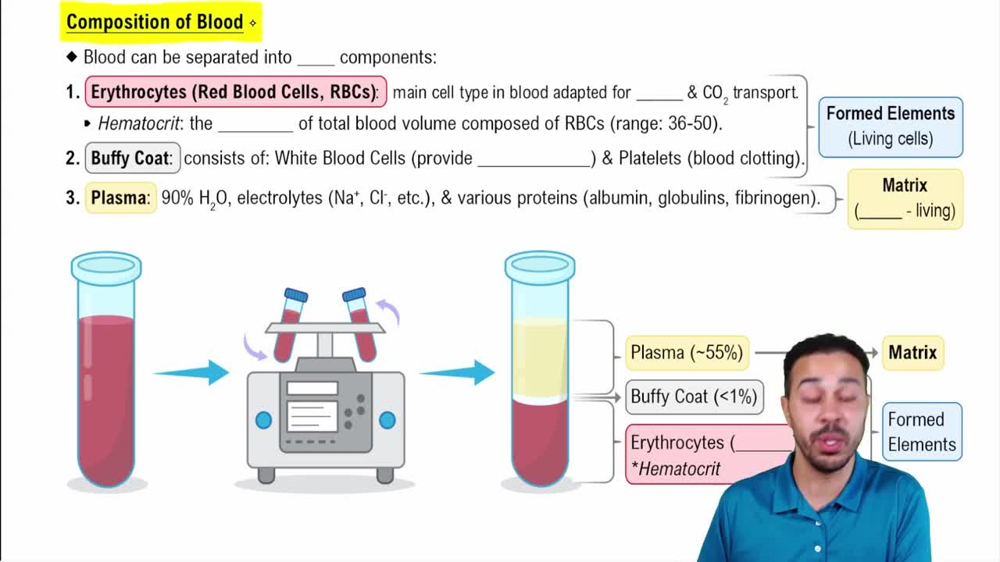
Recall that the buffy coat in a hematocrit tube is the thin layer between the plasma and red blood cells after centrifugation.
Recognize that the buffy coat contains the white blood cells and platelets, but not red blood cells.
Summarize that the buffy coat is composed of leukocytes and thrombocytes, which are less numerous than erythrocytes.
Verified video answer for a similar problem:
This video solution was recommended by our tutors as helpful for the problem above
Video duration:
1m
Play a video:
0 Comments
Key Concepts
Here are the essential concepts you must grasp in order to answer the question correctly.
Formed Elements of Blood
Formed elements are the cellular components of blood, including red blood cells (erythrocytes), white blood cells (leukocytes), and platelets (thrombocytes). These elements perform vital functions such as oxygen transport, immune defense, and blood clotting.
Among the formed elements, red blood cells are the most numerous, followed by platelets, while white blood cells are the least numerous. This difference in quantity reflects their distinct roles in the body.
The buffy coat is a thin layer in a centrifuged blood sample that contains white blood cells and platelets. It lies between the red blood cell layer and the plasma, indicating the presence of the less abundant formed elements.