Ch. 12 The Lymphatic System and Body Defenses
Marieb - Essentials of Human Anatomy & Physiology 13th Edition
Marieb13th EditionEssentials of Human Anatomy & PhysiologyISBN: 9780135624340Not the one you use?Change textbook
Chapter 12, Problem 16

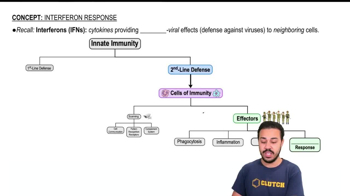
Interferons are referred to as antiviral proteins. What stimulates their production, and how do they protect uninfected cells?

Verified step by step guidance
1
Understand that interferons are a type of cytokine, which are signaling proteins produced by cells in response to specific stimuli, particularly viral infections.
Recognize that the production of interferons is stimulated when a cell detects the presence of viral components, such as double-stranded RNA or viral proteins, which are foreign to the host cell.
Learn that once produced, interferons bind to receptors on neighboring uninfected cells, triggering a signaling cascade that activates antiviral defense mechanisms within those cells.
Explore how interferons stimulate the production of antiviral proteins, such as protein kinase R (PKR), which inhibits viral replication by interfering with the translation of viral RNA.
Understand that interferons also enhance the activity of immune cells, such as natural killer (NK) cells and macrophages, to destroy infected cells and prevent the spread of the virus.

Verified video answer for a similar problem:

This video solution was recommended by our tutors as helpful for the problem above.
Video duration:
3m
Was this helpful?

Key Concepts

Here are the essential concepts you must grasp in order to answer the question correctly.

Interferons

Interferons are a group of signaling proteins produced by host cells in response to viral infections. They play a crucial role in the immune response by signaling neighboring cells to enhance their antiviral defenses. There are three main types: Type I (e.g., IFN-alpha and IFN-beta), Type II (IFN-gamma), and Type III (IFN-lambda), each with distinct functions in immune regulation.
Recommended video:
1:32
Interferons

Stimuli for Interferon Production

The production of interferons is primarily stimulated by the presence of viral components, such as double-stranded RNA, which is often produced during viral replication. Other stimuli include certain cytokines and pathogen-associated molecular patterns (PAMPs) recognized by pattern recognition receptors (PRRs) on host cells. This recognition triggers signaling pathways that lead to the transcription of interferon genes.
Recommended video:
1:32
Interferons

Mechanism of Action

Interferons protect uninfected cells by binding to specific receptors on their surface, initiating a signaling cascade that activates genes responsible for antiviral defenses. This results in the production of proteins that inhibit viral replication, enhance the immune response, and promote apoptosis in infected cells. Consequently, interferons create an antiviral state in neighboring cells, limiting the spread of the virus.
Recommended video:
03:53
Action Potential