
Textbook Question
Mark the following statements as true or false. If a statement is false, correct it to make a true statement.
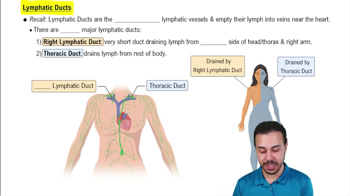
Lymph from the lower limbs drains into the right lymphatic duct.
638
views

 Verified step by step guidance
 3:57
3:57
 3:27
3:27Mark the following statements as true or false. If a statement is false, correct it to make a true statement.
Lymph from the lower limbs drains into the right lymphatic duct.
Complement proteins are crucial for stimulating phagocytes to clear immune complexes. Predict what type of hypersensitivity disorder might result from complement deficiencies. Explain what other consequences might arise from a complement deficiency.
Mark the following statements as true or false. If a statement is false, correct it to make a true statement.
Lymphatic vessels constitute a one-way system that delivers interstitial fluid from the blood vessels to the extracellular space.
The lymphoid organ that filters the blood is the ______, and the lymphoid organ that filters the lymph is the______.
Mark the following statements as true or false. If a statement is false, correct it to make a true statement.
The thymus is the site of maturation of B cells.
Mark the following statements as true or false. If a statement is false, correct it to make a true statement.
Clusters of MALT located around the oral and nasal cavities are known as Peyer's patches.