Name and describe the layers of the digestive tract, proceeding from the innermost layer nearest the lumen to the outermost layer.
Verified step by step guidance
1
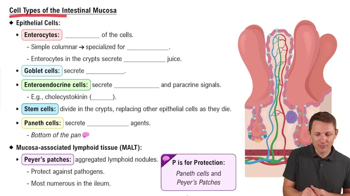
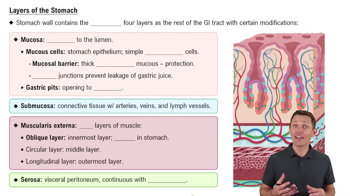
Identify the innermost layer of the digestive tract, which is the mucosa. Describe it as the layer that lines the lumen and is responsible for secretion, absorption, and protection. It consists of three sublayers: the epithelium, lamina propria, and muscularis mucosae.
Next, describe the submucosa, which lies just outside the mucosa. Explain that it is a dense connective tissue layer containing blood vessels, lymphatics, and nerves, providing support and nourishment to the mucosa.
Then, move to the muscularis externa, which is the layer outside the submucosa. Describe its role in producing peristalsis and segmentation movements. It typically has two layers of smooth muscle: an inner circular layer and an outer longitudinal layer.
Finally, describe the outermost layer, which varies depending on the location in the digestive tract. It is either the serosa (a visceral peritoneum layer) or the adventitia (a connective tissue layer). Explain that the serosa reduces friction with other organs, while the adventitia anchors the digestive tract to surrounding tissues.
Summarize the order of the layers from innermost to outermost as: mucosa, submucosa, muscularis externa, and serosa or adventitia, highlighting their structural and functional significance in the digestive system.
Verified video answer for a similar problem:
This video solution was recommended by our tutors as helpful for the problem above
Play a video:
0 Comments
Key Concepts
Here are the essential concepts you must grasp in order to answer the question correctly.
Mucosa
The mucosa is the innermost layer of the digestive tract lining the lumen. It consists of an epithelial layer, a connective tissue layer called the lamina propria, and a thin layer of muscle called the muscularis mucosae. This layer is responsible for secretion, absorption, and protection.
The submucosa lies just outside the mucosa and is made of dense connective tissue containing blood vessels, lymphatics, and nerves. It supports the mucosa and provides the digestive tract with elasticity and strength, as well as housing the submucosal nerve plexus that controls local secretions.
The muscularis externa consists of two or more layers of smooth muscle responsible for peristalsis and segmentation. The outermost layer is either the serosa, a protective visceral peritoneum, or the adventitia, connective tissue anchoring the tract to surrounding structures, depending on the location in the digestive system.