Ch. 23 The Respiratory System
Martini - Fundamentals of Anatomy & Physiology 11th Edition
Martini, Nath, Bartholomew11th EditionFundamentals of Anatomy & PhysiologyISBN: 9780136874089Not the one you use?Change textbook
Chapter 23, Problem 30

Doris has an obstruction of her right primary bronchus. As a result, how would the oxygen–hemoglobin saturation curve for her right lung compare with that for her left?

Verified step by step guidance
1
Understand the oxygen–hemoglobin saturation curve: This curve represents the relationship between the partial pressure of oxygen (PO₂) and the percentage of hemoglobin saturated with oxygen. Factors like oxygen availability, carbon dioxide levels, pH, and temperature can shift the curve.
Recognize the impact of the obstruction: An obstruction in the right primary bronchus reduces airflow to the right lung, leading to decreased oxygen levels (hypoxia) in the alveoli of the right lung. This will affect the oxygen–hemoglobin saturation curve for the right lung.
Analyze the physiological response: In the right lung, reduced oxygen levels will lower the partial pressure of oxygen (PO₂). This causes hemoglobin to release oxygen more readily, shifting the oxygen–hemoglobin saturation curve to the right for the right lung. This shift indicates decreased oxygen saturation at a given PO₂.
Compare with the left lung: The left lung, which is unaffected, will maintain normal oxygen levels and a normal oxygen–hemoglobin saturation curve. The curve for the left lung will remain in its typical position, reflecting normal oxygen saturation at a given PO₂.
Summarize the comparison: The oxygen–hemoglobin saturation curve for the right lung will be shifted to the right due to lower oxygen levels, while the curve for the left lung will remain unchanged, reflecting normal oxygen saturation.

Verified video answer for a similar problem:

This video solution was recommended by our tutors as helpful for the problem above.
Was this helpful?

Key Concepts

Here are the essential concepts you must grasp in order to answer the question correctly.

Oxygen-Hemoglobin Saturation Curve

The oxygen-hemoglobin saturation curve illustrates the relationship between the partial pressure of oxygen (pO2) and the percentage of hemoglobin saturated with oxygen. This curve is sigmoidal in shape, indicating that hemoglobin's affinity for oxygen increases as more oxygen molecules bind. Understanding this curve is crucial for analyzing how changes in oxygen availability affect oxygen transport in the lungs.
Recommended video:
7:52
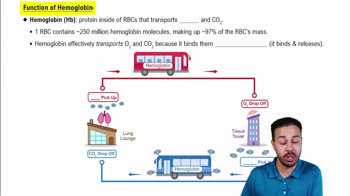
Function of Hemoglobin

Bronchial Obstruction

Bronchial obstruction refers to a blockage in the airways, which can significantly impair airflow and gas exchange in the affected lung. In Doris's case, the obstruction of the right primary bronchus would lead to reduced ventilation in the right lung, resulting in lower oxygen levels and potentially affecting the oxygen-hemoglobin saturation in that lung compared to the unobstructed left lung.
Recommended video:
Guided course
10:41
Secondary Messengers

Ventilation-Perfusion (V/Q) Ratio

The ventilation-perfusion (V/Q) ratio is a measure of the efficiency of gas exchange in the lungs, representing the relationship between air reaching the alveoli (ventilation) and blood flow in the pulmonary capillaries (perfusion). An obstruction in one bronchus can lead to a mismatch in this ratio, causing the affected lung to have lower oxygen saturation due to inadequate ventilation compared to the well-ventilated lung.
Recommended video:
Guided course
4:23
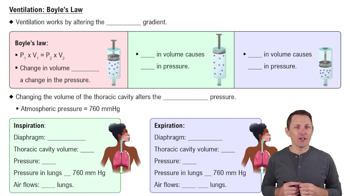
Ventilation: Boyle’s Law