Important functions of water include which of the following? a. Provides cushioning b. Acts as a transport medium c. Participates in chemical reactions d. Acts as a solvent for sugars, salts, and other solutes e. Reduces temperature fluctuations
Verified step by step guidance
1
Step 1: Understand the role of water in the human body by reviewing its physical and chemical properties, such as its polarity, high heat capacity, and ability to form hydrogen bonds.
Step 2: Analyze each option provided in the question to determine if it aligns with the known functions of water in Anatomy & Physiology. For example, water provides cushioning by absorbing shock in areas like joints and the brain.
Step 3: Consider water's role as a transport medium, which is essential for moving nutrients, gases, and waste products through the bloodstream and other bodily fluids.
Step 4: Evaluate water's participation in chemical reactions, such as hydrolysis and dehydration synthesis, which are critical for metabolic processes.
Step 5: Assess water's ability to act as a solvent for sugars, salts, and other solutes due to its polarity, and its role in reducing temperature fluctuations by absorbing and releasing heat slowly.
Verified video answer for a similar problem:

This video solution was recommended by our tutors as helpful for the problem above
Video duration:
2m
Play a video:
0 Comments
Key Concepts
Here are the essential concepts you must grasp in order to answer the question correctly.
Cushioning
Water provides cushioning for organs and tissues, acting as a shock absorber. This is particularly important in the human body, where water-filled spaces, such as synovial fluid in joints, help protect against impact and injury.
Water serves as a vital transport medium in biological systems, facilitating the movement of nutrients, gases, and waste products. Its liquid state allows for efficient circulation within organisms, such as blood in animals, which is primarily composed of water.
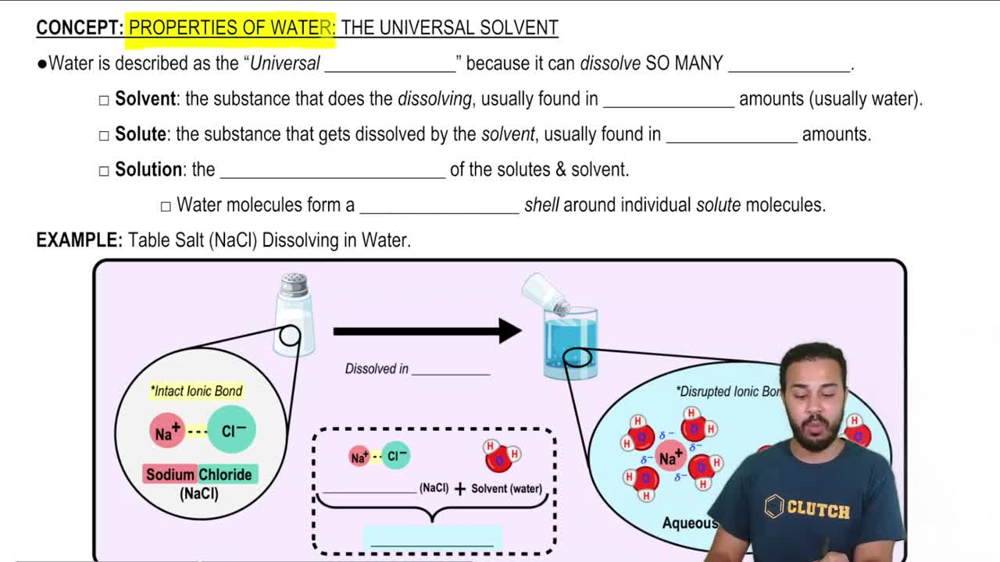
Water is often referred to as the 'universal solvent' due to its ability to dissolve a wide range of substances, including sugars, salts, and gases. This property is crucial for biochemical reactions and cellular processes, enabling the transport and interaction of various molecules.