Ch. 13 The Peripheral Nervous System and Reflex Activity
Marieb - Human Anatomy & Physiology 7th Edition
Marieb, Hoehn7th EditionHuman Anatomy & PhysiologyISBN: 9780805359091Not the one you use?Change textbook
Chapter 13, Problem 2

Proprioceptors include all of the following except
a. Muscle spindles
b. Tendon organs
c. Epithelial tactile complexes
d. Joint kinesthetic receptors

Verified step by step guidance
1
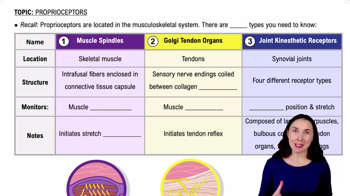
Step 1: Understand the definition of proprioceptors. Proprioceptors are sensory receptors located in muscles, tendons, and joints that provide information about body position, movement, and muscle tension.
Step 2: Identify the types of proprioceptors listed in the options. Muscle spindles detect changes in muscle length, tendon organs monitor tension in tendons, and joint kinesthetic receptors sense joint position and movement.
Step 3: Recognize that epithelial tactile complexes are not proprioceptors. Instead, they are mechanoreceptors found in the skin that detect touch and pressure, making them part of the somatosensory system but not involved in proprioception.
Step 4: Compare each option to the definition of proprioceptors to determine which one does not fit the category.
Step 5: Conclude that the correct answer is the option that is not a proprioceptor, based on the understanding of their functions and locations.

Verified video answer for a similar problem:

This video solution was recommended by our tutors as helpful for the problem above.
Video duration:
1m
Was this helpful?

Key Concepts

Here are the essential concepts you must grasp in order to answer the question correctly.

Proprioceptors

Proprioceptors are sensory receptors located in muscles, tendons, and joints that provide information about body position, movement, and muscle tension. They help maintain balance and coordinate movements by detecting changes in muscle length and tension.
Recommended video:
3:52
Proprioceptors

Muscle Spindles and Tendon Organs

Muscle spindles detect changes in muscle length and trigger reflexes to maintain muscle tone, while tendon organs monitor tension in tendons to prevent muscle damage. Both are key types of proprioceptors involved in sensing body position and movement.
Recommended video:
Guided course
7:12
Organization of Muscle Tissue

Epithelial Tactile Complexes

Epithelial tactile complexes, also known as Merkel discs, are mechanoreceptors found in the skin that detect light touch and pressure. Unlike proprioceptors, they are involved in tactile sensation rather than sensing body position or movement.
Recommended video:
2:31
Major Histocompatibility Complexes
Related Practice
Textbook Question

The large onion-shaped receptors that are found deep in the dermis and in subcutaneous tissue and that respond to deep pressure are

a. Epithelial tactile complexes

b. Lamellar corpuscles

c. Free nerve endings

d. Muscle spindles

1007
views
Textbook Question

Match the names of the cranial nerves in column B to the appropriate description in column A.

Column A 

_______    (1) Causes pupillary constriction 

_______    (2) The major sensory nerve of the face

_______    (3) Serves the sternocleido-mastoid and trapezius muscles 

_______    (4) Purely sensory (two nerves) 

_______    (5) Serves the tongue muscles 

_______    (6) Allows you to chew your food 

_______    (7) Impaired in Bell's palsy

_______    (8) Helps regulate heart activity

_______    (9) Helps you hear and maintain your balance 

_______   (10) Contain parasympathetic motor fibers (four nerves)

Column B

a. Abducens

b. Accessory

c. Facial

d. Glossopharyngeal

e. Hypoglossal

f. Oculomotor

g. Olfactory

h. Optic

i. Trigeminal

j. Trochlear

k. Vagus

l. Vestibulocochlear

1053
views
Textbook Question

The connective tissue sheath that surrounds a fascicle of nerve fibers is the

a. Epineurium

b. Endoneurium

c. Perineurium

d. Epimysium

1460
views
Textbook Question

Match the receptor type in column B to the correct description in column A.

Column A

______    (1) Pain, itch, and temperature receptors

______    (2) Contains intrafusal fibers and anulospiral and flower spray endings

______    (3) Discriminative touch receptor in hairless skin (fingertips)

______    (4) Contains receptor endings wrapped around thick collagen bundles

______    (5) Rapidly adapting deep-pressure receptor

______    (6) Slowly adapting deep-pressure receptor

Column B

a. Bulbous corpuscles

b. Tendon organ

c. Muscle spindle

d. Free nerve endings

e. Lamellar corpuscle

f. Tactile corpuscle

935
views