
Ch. 22 The Lymphatic System and Immunity
Martini - Fundamentals of Anatomy & Physiology 11th Edition
Martini, Nath, Bartholomew11th EditionFundamentals of Anatomy & PhysiologyISBN: 9780136874089Not the one you use?Change textbook
Chapter 22, Problem 15

What seven defenses, present at birth, provide the body with the defensive capability known as innate (nonspecific) immunity?

Verified step by step guidance
1
Understand that innate (nonspecific) immunity refers to the body's natural defense mechanisms that are present from birth and provide immediate protection against a wide range of pathogens without prior exposure.
Identify that these defenses are general and do not target specific pathogens, unlike adaptive immunity which develops later and is specific.
List the seven primary innate defenses, which include physical barriers, chemical barriers, and cellular responses.
The seven defenses are: 1) Skin and mucous membranes (physical barriers), 2) Secretions such as mucus, sweat, and tears (chemical barriers), 3) Cilia in the respiratory tract that trap and move particles, 4) Phagocytic cells like neutrophils and macrophages that engulf pathogens, 5) Natural killer (NK) cells that destroy infected or abnormal cells, 6) The inflammatory response that isolates and limits infection, and 7) Fever which inhibits pathogen growth and enhances immune function.
Summarize that these seven defenses work together to provide a rapid, nonspecific response to pathogens, forming the first line of defense in the immune system.

Verified video answer for a similar problem:

This video solution was recommended by our tutors as helpful for the problem above.
Was this helpful?

Key Concepts

Here are the essential concepts you must grasp in order to answer the question correctly.

Innate (Nonspecific) Immunity

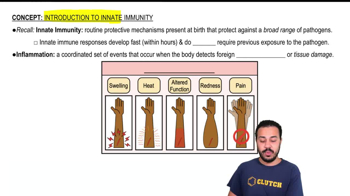
Innate immunity is the body's first line of defense against pathogens, present from birth. It provides immediate, nonspecific protection by recognizing general features of microbes rather than specific antigens, unlike adaptive immunity.
Recommended video:
2:30
Innate Immunity

Physical and Chemical Barriers

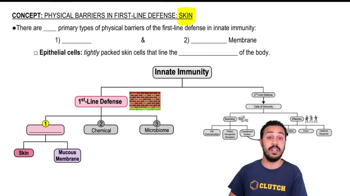
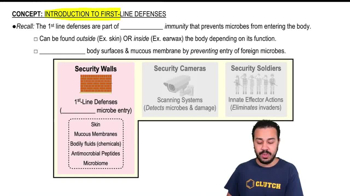
These include the skin, mucous membranes, and secretions like saliva and stomach acid that prevent pathogen entry. They act as the initial physical and chemical shields, blocking or destroying microbes before they invade deeper tissues.
Recommended video:
1:28
Physical Barriers

Cellular and Molecular Defenses

This includes phagocytic cells (like macrophages and neutrophils), natural killer cells, inflammation, fever, and antimicrobial proteins such as complement and interferons. These components identify and eliminate pathogens through various mechanisms without prior exposure.
Recommended video:
1:56
First-Line Defenses