More than one choice may apply. Which of the following is dependent on tubular secretion? a. Clearing penicillin from the blood b. Removal of nitrogenous wastes that have been reabsorbed c. Removal of excess potassium ions from the blood d. Control of blood pH
Verified step by step guidance
1
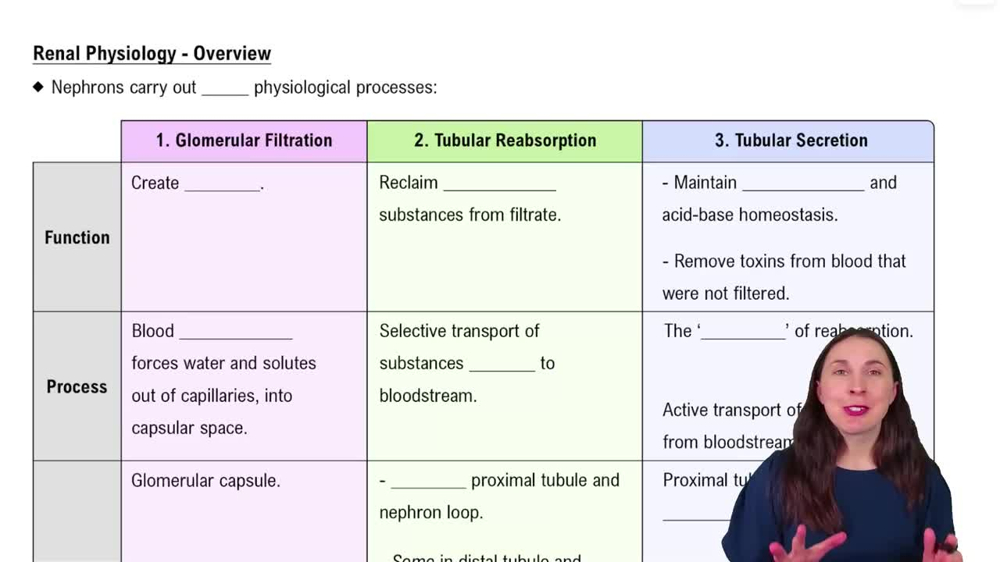
Understand the concept of tubular secretion: Tubular secretion is the process by which substances are actively transported from the blood in the peritubular capillaries into the renal tubules. This mechanism helps remove waste products, regulate ion concentrations, and maintain acid-base balance.
Analyze option (a): Clearing penicillin from the blood involves tubular secretion because penicillin is actively secreted into the renal tubules for excretion. This process bypasses filtration and relies on active transport mechanisms.
Analyze option (b): Removal of nitrogenous wastes that have been reabsorbed can involve tubular secretion. For example, urea and other nitrogenous wastes may be secreted back into the tubules after being reabsorbed in earlier stages of filtration.
Analyze option (c): Removal of excess potassium ions from the blood is dependent on tubular secretion. Potassium ions are actively secreted into the distal tubules and collecting ducts to regulate electrolyte balance.
Analyze option (d): Control of blood pH is dependent on tubular secretion. Hydrogen ions (H⁺) and bicarbonate ions (HCO₃⁻) are secreted or reabsorbed in the renal tubules to maintain acid-base balance in the blood.
Verified video answer for a similar problem:
This video solution was recommended by our tutors as helpful for the problem above
Video duration:
3m
Play a video:
0 Comments
Key Concepts
Here are the essential concepts you must grasp in order to answer the question correctly.
Tubular Secretion
Tubular secretion is a process in the kidneys where substances are actively transported from the blood into the renal tubules. This mechanism is crucial for eliminating waste products, regulating electrolyte balance, and maintaining acid-base homeostasis. It allows the body to excrete substances like drugs and excess ions that are not filtered by the glomerulus.
Renal clearance refers to the volume of plasma from which a substance is completely removed by the kidneys per unit time. It is an important measure for understanding how effectively the kidneys are functioning, particularly in the context of drugs like penicillin, which are cleared from the bloodstream through both filtration and secretion processes.
Acid-base balance is the regulation of the pH levels in the body fluids, primarily managed by the kidneys and lungs. The kidneys contribute by secreting hydrogen ions and reabsorbing bicarbonate, which helps control blood pH. This balance is vital for normal cellular function and overall metabolic processes.