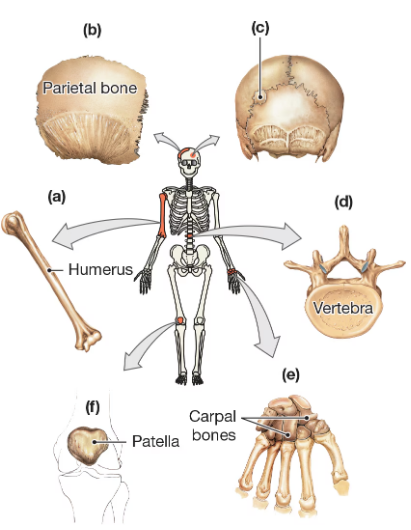
Classify the bones in the following diagram according to their shape. d. _____
Verified step by step guidance
1
Step 1: Identify the bone labeled (d) in the diagram, which is the vertebra.
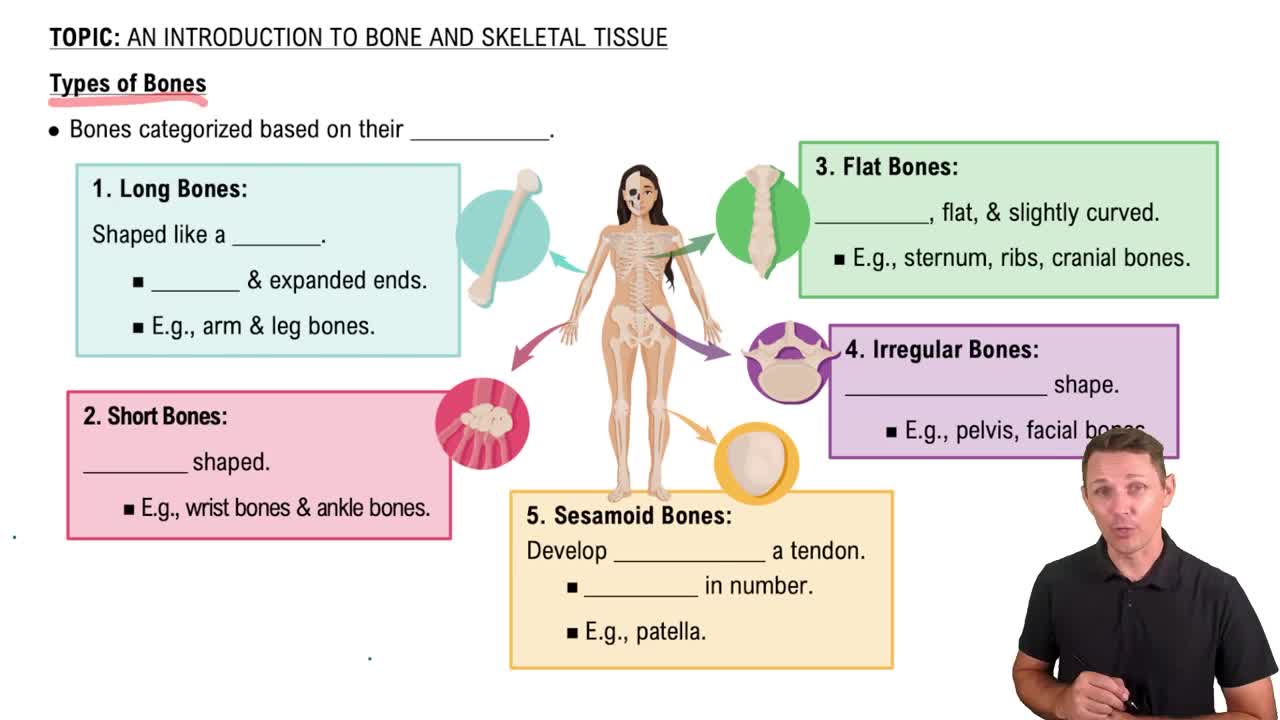
Step 2: Recall the classification of bones by shape: long bones, short bones, flat bones, irregular bones, and sesamoid bones.
Step 3: Understand that vertebrae are categorized as irregular bones because they have complex shapes that do not fit into the other categories.
Step 4: Confirm that the vertebra has a unique shape with projections and a central body, typical of irregular bones.
Step 5: Therefore, classify the bone labeled (d) as an irregular bone.
Verified video answer for a similar problem:
This video solution was recommended by our tutors as helpful for the problem above
Video duration:
2m
Play a video:
0 Comments
Key Concepts
Here are the essential concepts you must grasp in order to answer the question correctly.
Bone Classification by Shape
Bones are classified into four main shapes: long, short, flat, and irregular. Long bones are longer than they are wide and primarily support weight and facilitate movement. Short bones are roughly cube-shaped and provide stability with limited movement. Flat bones are thin and often curved, protecting internal organs. Irregular bones have complex shapes that do not fit into the other categories.
The humerus is a long bone found in the arm, essential for movement. The parietal bone is a flat bone forming part of the skull, protecting the brain. Vertebrae are irregular bones that make up the spine, providing support and protecting the spinal cord. Carpal bones are short bones in the wrist, allowing flexibility. The patella is a sesamoid bone embedded in a tendon, aiding knee movement.
To classify bones in a diagram, observe their shape and location. Long bones like the humerus have a shaft and two ends. Flat bones like the parietal bone are thin and curved. Irregular bones like vertebrae have complex shapes. Short bones like carpals are small and cube-like. Recognizing these features helps accurately classify bones in anatomical images.