
Ch. 25 Fluid, Electrolyte, and Acid-Base Homeostasis
Amerman - Human Anatomy & Physiology 2nd Edition
Amerman2nd EditionHuman Anatomy & PhysiologyISBN: 9780136873822Not the one you use?Change textbook
Chapter 25, Problem L2.3

Explain how the amount of water in the body affects the concentration of ions and solutes in the ECF.

Verified step by step guidance
1
Understand the concept of extracellular fluid (ECF): The ECF is the fluid outside of cells, including plasma and interstitial fluid. It contains ions (e.g., sodium, potassium, chloride) and solutes (e.g., glucose, proteins) that are essential for maintaining homeostasis.
Recognize the relationship between water volume and solute concentration: The concentration of ions and solutes in the ECF is determined by the ratio of solutes to the amount of water present. This relationship follows the principle of dilution, where increasing water volume decreases solute concentration, and decreasing water volume increases solute concentration.
Consider the effects of dehydration: When the body loses water (e.g., through sweating, urination, or insufficient intake), the concentration of ions and solutes in the ECF increases. This can lead to hypertonicity, where the ECF becomes more concentrated than the intracellular fluid, potentially causing water to move out of cells via osmosis.
Examine the effects of overhydration: When the body gains excess water (e.g., through excessive drinking or intravenous fluids), the concentration of ions and solutes in the ECF decreases. This can lead to hypotonicity, where the ECF becomes less concentrated than the intracellular fluid, potentially causing water to move into cells via osmosis.
Understand the importance of homeostasis: The body uses mechanisms like antidiuretic hormone (ADH) secretion, thirst regulation, and kidney function to maintain the balance of water and solutes in the ECF. These processes ensure that the concentration of ions and solutes remains within a range that supports normal cellular function.

Verified video answer for a similar problem:

This video solution was recommended by our tutors as helpful for the problem above.
Was this helpful?

Key Concepts

Here are the essential concepts you must grasp in order to answer the question correctly.

Extracellular Fluid (ECF)

Extracellular fluid refers to all body fluids outside of cells, including interstitial fluid and plasma. It plays a crucial role in maintaining homeostasis by providing a medium for nutrient and waste exchange. The concentration of ions and solutes in the ECF is vital for cellular function, as it influences osmotic balance and electrical gradients across cell membranes.
Recommended video:
Guided course
2:39
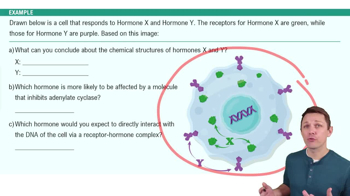
Intracellular Receptors and Direct Gene Action Example 1

Osmolarity

Osmolarity is a measure of the concentration of solute particles in a solution. In the context of body fluids, it affects the movement of water across cell membranes through osmosis. Changes in the amount of water in the body can alter osmolarity, leading to shifts in fluid balance between the ECF and intracellular fluid, which can impact cellular function and overall homeostasis.
Recommended video:
07:59
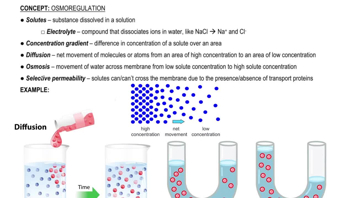
Osmosis and Osmolarity

Ion Concentration

Ion concentration refers to the amount of charged particles, such as sodium, potassium, and chloride, present in a solution. In the ECF, the concentration of these ions is critical for various physiological processes, including nerve impulse transmission and muscle contraction. The amount of water in the body directly influences ion concentration; an increase in water dilutes ions, while a decrease concentrates them, affecting cellular activities.
Recommended video:
04:51
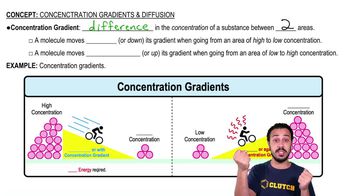
Concentration Gradients and Diffusion
Related Practice
Textbook Question

Elise Anderson is a 6-year-old girl who presents to the emergency department with a history of vomiting for the past 3 days. The nurse notices that her respiratory rate is abnormally low. What is the likely reason for this change in ventilation? Predict what Elise's arterial blood gas values would show.

359
views
Textbook Question

A woman begins a diet and exercise regimen and loses 30 lb. Will her total body water increase, decrease, or stay the same? Why?

438
views
Textbook Question

Your friend argues that all water conducts electricity, regardless of what it contains. You prepare three liquids to test this hypothesis: one with deionized water (with no solutes, only water molecules), one with 5% glucose in water, and one with 5% sodium chloride in water. Which of these solutions, if any, will conduct an electric current? Explain.

372
views
Textbook Question

Diabetic ketoacidosis is characterized by an increased level of ketone bodies, which causes metabolic acidosis. A patient in diabetic ketoacidosis will have an altered rate of ventilation. Will the patient be hyperventilating or hypoventilating? How will a change in the rate and depth of ventilation compensate for an acidosis that is metabolic in nature?

445
views
Textbook Question

What happens to the concentration of sodium ions in the ECF if you consume a large amount of salt without consuming any water? How will this affect the osmotic pressure of the ECF? Why could this lead to an elevation in blood pressure?

628
views
Textbook Question

What happens to the pH of a solution when hydrogen ions are added?

a. The pH increases.

b. The pH decreases.

c. The pH does not change.

d. The pH does not measure hydrogen ion concentration.

797
views