Water has a high heat-absorbing capacity because .a. the sun's rays penetrate to the bottom of bodies of water, mainly heating the bottom surface;b. the strong covalent bonds that hold individual water molecules together require large inputs of heat to break;c. it has the ability to dissolve many heat-resistant solutes;d. initial energy inputs are first used to break hydrogen bonds between water molecules and only after these are broken, to raise the temperature;e. all of the above are true
Verified step by step guidance
1
Identify the key property of water being discussed: its high heat-absorbing capacity.
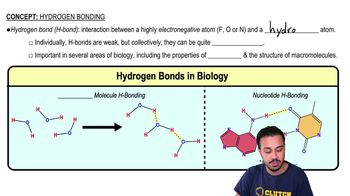
Consider the structure of water molecules: Water molecules are polar and form hydrogen bonds with each other.
Analyze each option: (a) Sun's rays heating the bottom surface doesn't relate to heat absorption capacity. (b) Covalent bonds within water molecules are strong, but they are not broken during heating. (c) Dissolving solutes doesn't directly relate to heat absorption. (d) Hydrogen bonds between water molecules require energy to break, which is relevant to heat absorption. (e) Evaluate if all options are true or if one is most relevant.
Focus on option (d): Initial energy inputs break hydrogen bonds, which is a key factor in water's heat-absorbing capacity.
Conclude that the ability to absorb heat is primarily due to the energy required to break hydrogen bonds, as described in option (d).
Verified video answer for a similar problem:
This video solution was recommended by our tutors as helpful for the problem above
Video duration:
1m
Play a video:
0 Comments
Key Concepts
Here are the essential concepts you must grasp in order to answer the question correctly.
Heat Capacity
Heat capacity is the amount of heat energy required to change the temperature of a substance. Water has a high heat capacity, meaning it can absorb a significant amount of heat without a large increase in temperature. This property is crucial for regulating temperatures in natural environments and is essential for various biological processes.
Hydrogen bonds are weak attractions between the hydrogen atom of one water molecule and the oxygen atom of another. These bonds play a critical role in water's unique properties, including its high heat capacity. When heat is added to water, much of the energy is initially used to break these hydrogen bonds before the temperature of the water itself begins to rise.
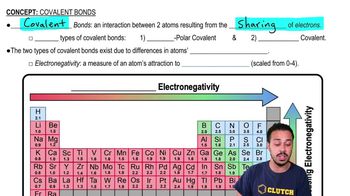
Covalent bonds are strong chemical bonds formed when atoms share electrons. In water, each molecule consists of two hydrogen atoms covalently bonded to one oxygen atom. While covalent bonds contribute to the stability of water molecules, it is the hydrogen bonds between them that significantly influence water's thermal properties, including its heat-absorbing capacity.

 1:16 minutes
 Verified step by step guidance
 6:38
6:38