Ch. 29 Heredity

Marieb, Hoehn11th EditionHuman Anatomy & PhysiologyISBN: 9780136874034
Not the one you use?Change textbookSelect a different textbook
Table of contents
- Ch. 1 The Human Body: An Orientation24
- Ch. 2 Chemistry Comes Alive25
- Ch. 3 Cells: The Living Units21
- Ch. 4 Tissue: The Living Fabric20
- Ch. 5 The Integumentary System11
- Ch. 6 Bones and Skeletal Tissues19
- Ch. 7 The Skeleton14
- Ch. 8 Joints7
- Ch. 9 Muscles and Muscle Tissue26
- Ch. 10 The Muscular System26
- Ch. 11 Fundamentals of the Nervous System and Nervous Tissue19
- Ch. 12 The Central Nervous System26
- Ch. 13 The Peripheral Nervous System and Reflex Activity32
- Ch. 14 The Autonomic Nervous System19
- Ch. 15 The Special Senses26
- Ch. 16 The Endocrine System23
- Ch. 17 Blood25
- Ch. 18 The Cardiovascular System: The Heart24
- Ch. 19 The Cardiovascular System: Blood Vessels27
- Ch. 20 The Lymphatic System and Lymphoid Organs and Tissues14
- Ch. 21 The Immune System: Innate and Adaptive Body Defenses27
- Ch. 22 The Respiratory System21
- Ch. 23 The Digestive System31
- Ch. 24 Nutrition, Metabolism, and Energy Balance26
- Ch. 25 The Urinary System26
- Ch. 26 Fluid, Electrolyte, and Acid-Base Balance24
- Ch. 27 The Reproductive System24
- Ch. 28 Pregnancy and Human Development25
- Ch. 29 Heredity11
Marieb, Hoehn11th EditionHuman Anatomy & PhysiologyISBN: 9780136874034Not the one you use?Change textbook

Chapter 29, Problem 4
Suppose that the ability to taste PTC (phenylthiocarbamide) depends on the presence of a dominant gene T; nontasters are homozygous for the recessive gene t. This would be a case of classical dominant-recessive inheritance.
(a) Consider a mating between heterozygous parents producing three offspring. What proportion of the offspring are likely to be tasters? What is the chance that all three offspring will be tasters? Nontasters? What is the chance that two will be tasters and one will be a nontaster?
(b) Consider a mating between Tt and tt parents. What is the anticipated percentage of tasters? Nontasters? What proportion can be expected to be homozygous recessive? Heterozygous? Homozygous dominant?
 Verified step by step guidance
1
Understand the genetic basis: The ability to taste PTC is controlled by a dominant gene T. Tasters have at least one T allele (TT or Tt), while nontasters are homozygous recessive (tt).
For part (a), set up a Punnett square for two heterozygous parents (Tt x Tt). The possible genotypes of offspring are TT, Tt, and tt with probabilities 1/4, 1/2, and 1/4 respectively. Calculate the proportion of tasters by adding probabilities of TT and Tt.
Calculate the probability that all three offspring are tasters by raising the tasters' probability to the power of 3: \((\text{probability of taster})^3\). Similarly, calculate the probability that all three are nontasters by raising the nontaster probability to the power of 3.
Calculate the probability that exactly two offspring are tasters and one is a nontaster using the binomial probability formula: \(P = \binom{3}{2} \times (\text{probability of taster})^2 \times (\text{probability of nontaster})^1\).
For part (b), set up a Punnett square for parents Tt and tt. The possible offspring genotypes are Tt and tt with equal probabilities. Calculate the percentage of tasters (Tt), nontasters (tt), and identify the proportions of homozygous dominant (TT), heterozygous (Tt), and homozygous recessive (tt) offspring.
Key Concepts
Here are the essential concepts you must grasp in order to answer the question correctly.
Mendelian Dominant-Recessive Inheritance
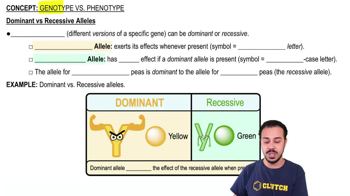
This concept explains how traits are inherited through dominant and recessive alleles. A dominant allele (T) masks the effect of a recessive allele (t) in heterozygous individuals, so only those with two recessive alleles (tt) express the recessive trait. Understanding this helps predict offspring phenotypes based on parental genotypes.
Recommended video:
 03:39
03:39
Dominant vs. Recessive Alleles
Punnett Square and Genotypic Ratios
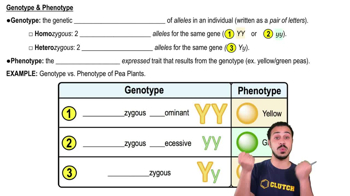
A Punnett square is a tool used to determine the possible genotypes of offspring from parental alleles. It helps calculate the expected proportions of homozygous dominant (TT), heterozygous (Tt), and homozygous recessive (tt) genotypes, which in turn predict phenotypic ratios such as tasters and nontasters.
Recommended video:
 06:36
06:36Genotype & Phenotype
Probability in Independent Events
When considering multiple offspring, the probability of specific genotype or phenotype combinations is calculated by multiplying individual probabilities, assuming independent assortment. This allows determination of chances for all offspring being tasters, nontasters, or mixed combinations in a given number of offspring.
Recommended video:
 2:08
2:08T Dependent & T Independent Antigens
Related Practice