Which of the following is not a function of mitosis in humans?a. repair of woundsb. growthc. production of gametes from diploid cellsd. replacement of lost or damaged cells
Verified step by step guidance
1
Identify the primary purpose of mitosis in human cells, which is to divide a single cell into two genetically identical daughter cells.
Understand that mitosis is crucial for processes such as growth, where increased cell numbers are required, and for repair and replacement of cells, where damaged or dead cells need to be replaced.
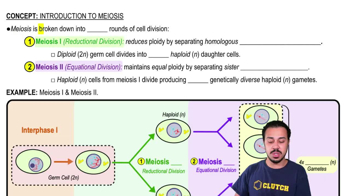
Recognize that gametes (sperm and eggs) are produced through a different process called meiosis, not mitosis. Meiosis involves reducing the chromosome number by half to produce haploid cells, which is essential for sexual reproduction.
Review each option and determine whether it aligns with the function of mitosis: repair of wounds and replacement of cells involve cell division for tissue maintenance and healing, both of which are functions of mitosis.
Conclude that the production of gametes from diploid cells is not a function of mitosis but rather of meiosis, making option 'c' the correct answer.
Verified video answer for a similar problem:
This video solution was recommended by our tutors as helpful for the problem above
Video duration:
2m
Play a video:
0 Comments
Key Concepts
Here are the essential concepts you must grasp in order to answer the question correctly.
Mitosis
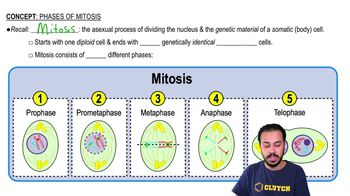
Mitosis is a type of cell division that results in two genetically identical daughter cells from a single parent cell. It is essential for growth, tissue repair, and asexual reproduction in multicellular organisms. Mitosis involves several stages: prophase, metaphase, anaphase, and telophase, culminating in cytokinesis.
The primary functions of mitosis include growth, repair of tissues, and replacement of lost or damaged cells. These processes are vital for maintaining healthy tissue and ensuring that organisms can develop and recover from injuries. Mitosis does not involve the production of gametes, which is a function of meiosis.
Meiosis is a specialized form of cell division that reduces the chromosome number by half, resulting in four non-identical gametes. It is crucial for sexual reproduction, allowing for genetic diversity through the combination of genetic material from two parents. Unlike mitosis, meiosis includes two rounds of division and is responsible for producing sperm and eggs.

 2:11 minutes
 Verified step by step guidance
 03:21
03:21