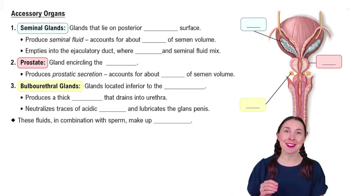
Understand that the male urethra is divided into three main anatomical regions based on their location and surrounding structures.
Identify the first region as the prostatic urethra, which passes through the prostate gland and is the widest part of the urethra.
Recognize the second region as the membranous urethra, which is the shortest and narrowest part, passing through the urogenital diaphragm.
Identify the third region as the spongy (or penile) urethra, which runs through the length of the penis within the corpus spongiosum and ends at the external urethral orifice.
Summarize the three regions as: prostatic urethra, membranous urethra, and spongy (penile) urethra.
Verified video answer for a similar problem:
This video solution was recommended by our tutors as helpful for the problem above
Play a video:
0 Comments
Key Concepts
Here are the essential concepts you must grasp in order to answer the question correctly.
Prostatic Urethra
The prostatic urethra is the portion of the male urethra that passes through the prostate gland. It is the widest and most dilatable part, receiving the ejaculatory ducts and prostatic ducts, playing a key role in both urinary and reproductive systems.
The membranous urethra is the short, narrow segment that passes through the urogenital diaphragm. It is surrounded by the external urethral sphincter, which controls voluntary urination, making it crucial for urinary continence.
The spongy urethra runs through the corpus spongiosum of the penis and extends to the external urethral orifice. It is the longest part of the male urethra and serves as a conduit for urine and semen to exit the body.