Mark the following statements as true or false. If a statement is false, correct it to make a true statement. c. Hyperkalemia tends to decrease the resting membrane potential and hyperpolarize excitable cells.
Verified step by step guidance
1
Understand the key terms in the statement: 'Hyperkalemia' refers to an elevated level of potassium ions (K⁺) in the blood, and 'resting membrane potential' is the electrical charge difference across the cell membrane when the cell is at rest.
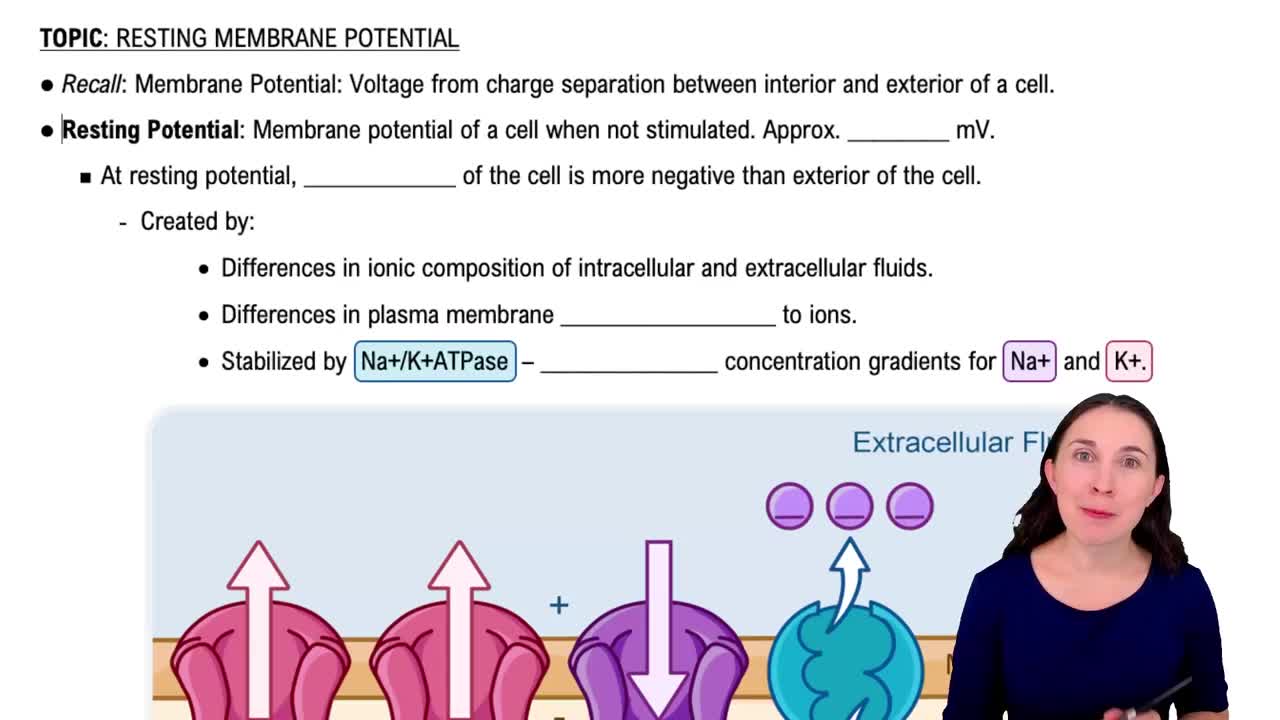
Recall that the resting membrane potential is primarily maintained by the sodium-potassium pump and the relative permeability of the membrane to potassium ions. Potassium ions play a major role in determining the resting membrane potential because the membrane is more permeable to K⁺ than to other ions.
Analyze the effect of hyperkalemia: When extracellular K⁺ levels increase, the concentration gradient for K⁺ across the membrane decreases. This reduces the efflux (outward movement) of K⁺ from the cell, making the inside of the cell less negative (depolarized) rather than more negative (hyperpolarized).
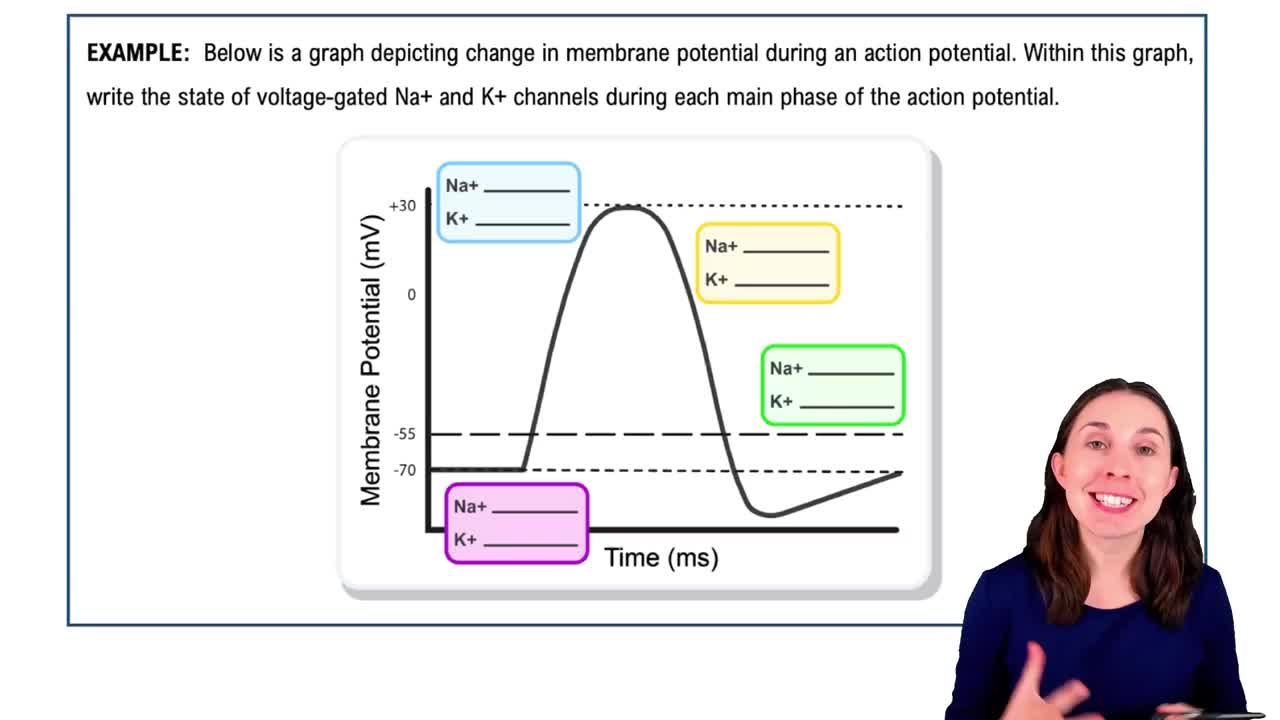
Evaluate the statement: The claim that hyperkalemia 'decreases the resting membrane potential and hyperpolarizes excitable cells' is incorrect. Hyperkalemia actually decreases the resting membrane potential (makes it less negative) and depolarizes excitable cells, increasing their excitability.
Correct the statement: The corrected version of the statement should read, 'Hyperkalemia tends to decrease the resting membrane potential and depolarize excitable cells.'
Verified video answer for a similar problem:
This video solution was recommended by our tutors as helpful for the problem above
Play a video:
0 Comments
Key Concepts
Here are the essential concepts you must grasp in order to answer the question correctly.
Hyperkalemia
Hyperkalemia refers to an elevated level of potassium in the blood. Potassium is crucial for maintaining the resting membrane potential of cells, particularly in excitable tissues like muscle and nerve cells. High potassium levels can disrupt normal cellular function, leading to various physiological effects.
Renal Physiology Step 2: Tubular Reabsorption Example 6
Resting Membrane Potential
The resting membrane potential is the electrical potential difference across the cell membrane when a cell is not actively transmitting signals. It is primarily determined by the distribution of ions, especially sodium and potassium, across the membrane. A decrease in resting membrane potential can make cells more depolarized and less excitable.
Hyperpolarization is an increase in the membrane potential, making the inside of the cell more negative compared to the outside. This process makes it more difficult for a cell to reach the threshold for action potential generation, thus reducing excitability. In the context of hyperkalemia, the statement incorrectly suggests that hyperkalemia causes hyperpolarization, when it actually leads to depolarization.