Compare bone to cartilage tissue relative to its resilience, speed of regeneration, and access to nutrients.
Ch. 6 Bones and Skeletal Tissues

Marieb, Hoehn7th EditionHuman Anatomy & PhysiologyISBN: 9780805359091Not the one you use?Change textbook
Chapter 6, Problem 16
Yolanda is asked to review a bone slide that her professor has set up under the microscope. She sees concentric layers surrounding a central cavity. Is this bone section taken from the diaphysis or the epiphyseal plate of the specimen?
Verified step by step guidance1
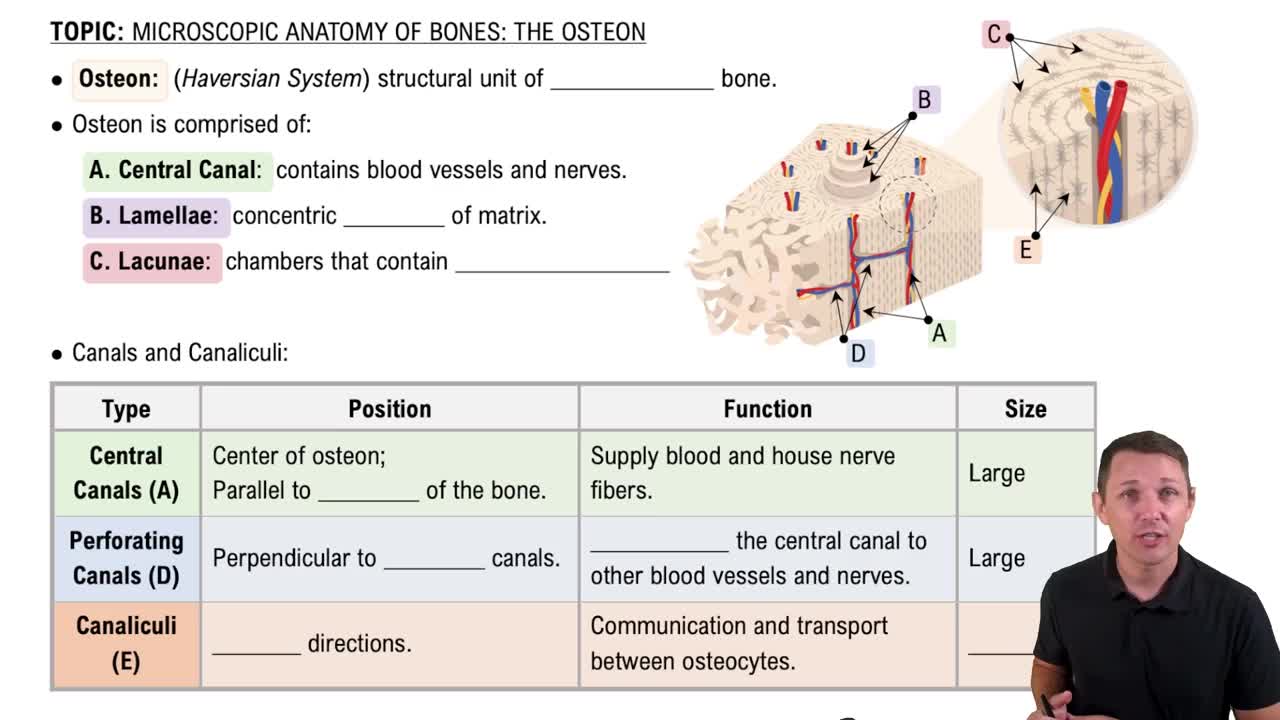
Step 1: Understand the structure described. Concentric layers surrounding a central cavity are characteristic of an osteon or Haversian system, which is the fundamental functional unit of compact bone.
Step 2: Recall the locations of bone structures. The diaphysis is the shaft of a long bone and is primarily composed of compact bone containing osteons, while the epiphyseal plate is a region of hyaline cartilage involved in bone growth and does not contain osteons.
Step 3: Identify the tissue type based on the microscopic features. Since concentric lamellae (layers) around a central canal are features of compact bone, this indicates the section is from compact bone tissue.
Step 4: Connect the tissue type to the bone region. Compact bone with osteons is found mainly in the diaphysis, whereas the epiphyseal plate consists of cartilage and lacks osteons.
Step 5: Conclude that the bone section with concentric layers around a central cavity is from the diaphysis, not the epiphyseal plate.

Verified video answer for a similar problem:
This video solution was recommended by our tutors as helpful for the problem above.
Video duration:
2mWas this helpful?
Key Concepts
Here are the essential concepts you must grasp in order to answer the question correctly.
Bone Microstructure - Osteon
An osteon is the fundamental functional unit of compact bone, characterized by concentric lamellae (layers) surrounding a central canal (Haversian canal) that contains blood vessels and nerves. Recognizing osteons helps identify compact bone tissue under the microscope.
Recommended video:
Guided course
Osteon
Diaphysis vs. Epiphyseal Plate
The diaphysis is the shaft of a long bone composed mainly of compact bone with osteons, while the epiphyseal plate is a region of hyaline cartilage found at the ends of long bones where growth occurs. The epiphyseal plate lacks the concentric lamellar structure seen in osteons.
Recommended video:
Passive vs. Active Transport
Histological Differences Between Bone Regions
Compact bone in the diaphysis shows organized osteons with concentric layers, whereas the epiphyseal plate consists of cartilage cells arranged in zones of proliferation and hypertrophy without concentric lamellae. Identifying these differences aids in determining the bone section's origin.
Recommended video:
Guided course
The Difference Between Anatomy and Physiology
Related Practice
Textbook Question
838
views
Textbook Question
Compare and contrast controls of bone remodeling exerted by hormones and by mechanical and gravitational forces, including the purpose of each control system and changes in bone architecture that might occur.
532
views
Textbook Question
Describe the process of new bone formation in an adult bone. Use the terms "osteoid seam" and "calcification front" in your discussion.
946
views
Textbook Question
a. Why are fractures most common in elderly individuals?
b. Why are greenstick fractures most common in children?
711
views
Textbook Question
Why do you think wheelchair-bound people with paralyzed lower limbs have thin, weak bones of the leg and thigh?
1024
views
Textbook Question
As we grow, our long bones increase in diameter, but the thickness of the compact bone of the shaft remains relatively constant. Explain this phenomenon.
1026
views