Give a function for each of the following: (f) Stromal cells (g) Epithelial reticular cells (h) Interferons (i) Pyrogens (j) T cells (k) B cells
Verified step by step guidance
1
Step 1: Define stromal cells and their function. Stromal cells are connective tissue cells that provide structural support in various organs. They play a role in maintaining the extracellular matrix and supporting the function of parenchymal cells.
Step 2: Explain epithelial reticular cells and their function. Epithelial reticular cells are specialized cells found in the thymus. They form a supportive framework for developing T cells and help regulate their maturation by producing thymic hormones.
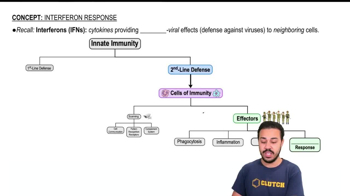
Step 3: Describe interferons and their function. Interferons are signaling proteins released by host cells in response to viral infections. They help inhibit viral replication and activate immune cells, such as natural killer cells and macrophages.
Step 4: Clarify pyrogens and their function. Pyrogens are substances, often produced by pathogens or immune cells, that induce fever by acting on the hypothalamus to increase the body's temperature set point.
Step 5: Differentiate T cells and B cells and their functions. T cells are lymphocytes involved in cell-mediated immunity, responsible for directly attacking infected or cancerous cells. B cells are lymphocytes involved in humoral immunity, producing antibodies to neutralize pathogens.
Verified video answer for a similar problem:
This video solution was recommended by our tutors as helpful for the problem above
Play a video:
0 Comments
Key Concepts
Here are the essential concepts you must grasp in order to answer the question correctly.
Stromal Cells
Stromal cells are the supportive tissue cells found in various organs, providing structural support and playing a crucial role in the immune response. They produce extracellular matrix components and secrete various cytokines that influence the behavior of immune cells. In the context of lymphoid organs, stromal cells help in the development and differentiation of lymphocytes.
Interferons are a group of signaling proteins produced by host cells in response to viral infections and other stimuli. They play a vital role in the immune response by inhibiting viral replication, activating immune cells, and enhancing the recognition of infected cells. Interferons are classified into three main types: Type I (e.g., IFN-α and IFN-β), Type II (IFN-γ), and Type III (IFN-λ), each with distinct functions.
T cells and B cells are two main types of lymphocytes that play critical roles in the adaptive immune response. T cells are involved in cell-mediated immunity, recognizing and destroying infected or cancerous cells, while B cells are responsible for humoral immunity, producing antibodies that neutralize pathogens. Both cell types originate from hematopoietic stem cells in the bone marrow and undergo maturation in different lymphoid organs.