
Textbook Question
Carbohydrates are acted on by:
a. Peptidases, trypsin, and chymotrypsin
b. Amylase, maltase, and sucrase
c. Lipases
d. Peptidases, lipases, and galactase
120
views

 Verified step by step guidance
 2:31
2:31
 02:55
02:55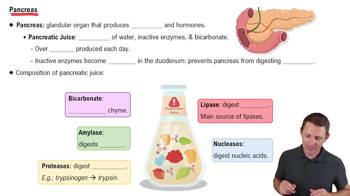 4:46
4:46Carbohydrates are acted on by:
a. Peptidases, trypsin, and chymotrypsin
b. Amylase, maltase, and sucrase
c. Lipases
d. Peptidases, lipases, and galactase
The site of production of cholecystokinin is:
a. The stomach
b. The small intestine
c. The pancreas
d. The large intestine
Which of the following is not characteristic of the colon?
a. It is divided into ascending, transverse, and descending portions
b. It contains abundant bacteria, some of which synthesize certain vitamins
c. It is the main absorptive site
d. It absorbs much of the water and salts remaining in the wastes
The parasympathetic nervous system influences digestion by:
a. Relaxing smooth muscle
b. Stimulating peristalsis and secretory activity
c. Constricting sphincters
d. None of these
The lamina propria forms part of the:
a. Muscularis externa
b. Submucosa
c. Serosa
d. Mucosa
The gallbladder
a. Produces bile
b. Is attached to the pancreas
c. Stores and concentrates bile
d. Produces secretin