Ch. 29 Development and Inheritance
Martini - Fundamentals of Anatomy & Physiology 11th Edition
Martini, Nath, Bartholomew11th EditionFundamentals of Anatomy & PhysiologyISBN: 9780136874089Not the one you use?Change textbook
Chapter 28, Problem 8

If an allele must be present on both the maternal and paternal chromosomes to affect the phenotype, the allele is said to be 
(a) Dominant
(b) Recessive
(c) Complementary
(d) Heterozygous

Verified step by step guidance
1
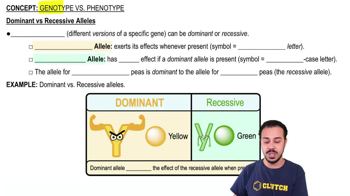
Understand the definitions of the key genetic terms involved: 'Dominant' alleles express their trait when present on just one chromosome, while 'Recessive' alleles require presence on both chromosomes (maternal and paternal) to affect the phenotype.
Recall that an allele is a variant form of a gene located at a specific position (locus) on a chromosome, and individuals inherit one allele from each parent for each gene.
Analyze the condition given: the allele must be present on both maternal and paternal chromosomes to affect the phenotype, which means the trait only shows up if the individual has two copies of that allele.
Match this condition to the correct term: since the trait only appears when both alleles are the same recessive form, the allele is described as 'Recessive'.
Confirm that 'Dominant' alleles do not require two copies to affect phenotype, 'Complementary' refers to interaction between different genes, and 'Heterozygous' describes having two different alleles, so these options do not fit the condition.

Verified video answer for a similar problem:

This video solution was recommended by our tutors as helpful for the problem above.
Was this helpful?

Key Concepts

Here are the essential concepts you must grasp in order to answer the question correctly.

Allele

An allele is a variant form of a gene found at a specific position on a chromosome. Each individual inherits two alleles for each gene, one from each parent, which together influence the organism's traits or phenotype.
Recommended video:
03:39
Dominant vs. Recessive Alleles

Dominant and Recessive Alleles

Dominant alleles express their trait even if only one copy is present, while recessive alleles require both copies (from maternal and paternal chromosomes) to be the same for the trait to appear. This explains why some traits only show up when the allele is homozygous recessive.
Recommended video:
03:39
Dominant vs. Recessive Alleles

Homozygous and Heterozygous Genotypes

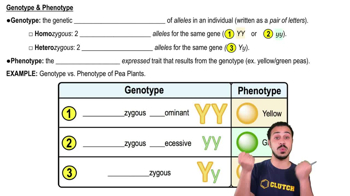
Homozygous means having two identical alleles for a gene, while heterozygous means having two different alleles. The phenotype depends on whether the alleles are dominant or recessive and their combination in the genotype.
Recommended video:
06:36
Genotype & Phenotype