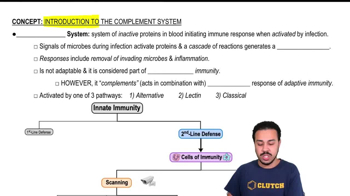
Complement activation promotes all of the following except: a. Cell lysis b. Inflammation c. Opsonization d. Interferon release e. Chemotaxis of neutrophils and other cell
Verified step by step guidance
1
Step 1: Understand the role of the complement system in the immune response. Complement activation is part of the innate immune system and helps defend against pathogens through several mechanisms.
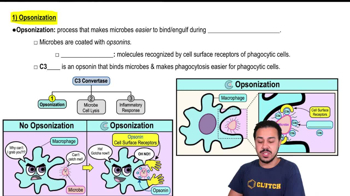
Step 2: Review the known effects of complement activation: it promotes cell lysis by forming membrane attack complexes, enhances inflammation by releasing anaphylatoxins, facilitates opsonization by coating pathogens to enhance phagocytosis, and attracts immune cells like neutrophils through chemotaxis.
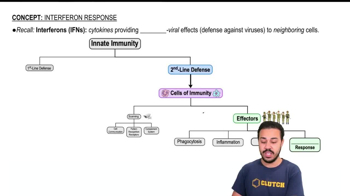
Step 3: Identify which option does not fit with the known functions of complement activation. Interferon release is typically associated with viral infections and is produced by infected cells or immune cells, not directly by complement activation.
Step 4: Compare each option to the functions of complement activation: a) Cell lysis - yes, b) Inflammation - yes, c) Opsonization - yes, d) Interferon release - no, e) Chemotaxis - yes.
Step 5: Conclude that the correct answer is the one that complement activation does not promote, which is interferon release.
Verified video answer for a similar problem:
This video solution was recommended by our tutors as helpful for the problem above
Video duration:
6m
Play a video:
0 Comments
Key Concepts
Here are the essential concepts you must grasp in order to answer the question correctly.
Complement System and Its Functions
The complement system is a group of proteins that enhance immune responses by promoting cell lysis, inflammation, opsonization, and chemotaxis. It helps destroy pathogens directly or marks them for removal by immune cells.
Opsonization is the process where complement proteins coat pathogens, making them easier for phagocytes to recognize and engulf. This enhances the efficiency of the immune response by facilitating pathogen clearance.
Interferons are signaling proteins released mainly by virus-infected cells to inhibit viral replication and activate immune cells. Unlike complement activation, interferon release is not a direct function of the complement system.