Which action could produce a carbonyl group?a. the replacement of the —OH of a carboxyl group with hydrogenb. the addition of a thiol to a hydroxylc. the addition of a hydroxyl to a phosphated. the replacement of the nitrogen of an amine with oxygen
Verified step by step guidance
1
Identify the structure of a carbonyl group, which is characterized by a carbon atom double-bonded to an oxygen atom (C=O).
Examine option (a): Replacing the —OH of a carboxyl group (—COOH) with hydrogen would result in a carbonyl group (C=O) as it forms an aldehyde (R-CHO).
Consider option (b): Adding a thiol (—SH) to a hydroxyl (—OH) does not form a carbonyl group; it forms a different functional group.
Evaluate option (c): Adding a hydroxyl (—OH) to a phosphate group does not result in a carbonyl group; it modifies the phosphate group.
Analyze option (d): Replacing the nitrogen of an amine (—NH2) with oxygen would form a different functional group, not a carbonyl group.
Verified video answer for a similar problem:
This video solution was recommended by our tutors as helpful for the problem above
Video duration:
2m
Play a video:
0 Comments
Key Concepts
Here are the essential concepts you must grasp in order to answer the question correctly.
Carbonyl Group
A carbonyl group is a functional group characterized by a carbon atom double-bonded to an oxygen atom (C=O). It is a key feature in various organic compounds, including aldehydes and ketones. Understanding how carbonyl groups are formed and their reactivity is essential for predicting the outcomes of chemical reactions.
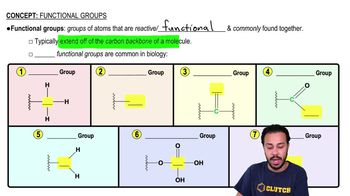
Functional groups are specific groups of atoms within molecules that are responsible for the characteristic chemical reactions of those molecules. In the context of the question, recognizing how different functional groups, such as hydroxyl (-OH), carboxyl (-COOH), and amine (-NH2), can be transformed or replaced is crucial for determining the formation of a carbonyl group.
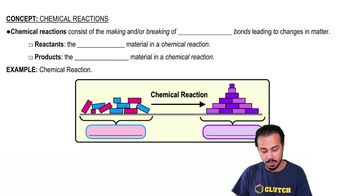
Chemical reactions involve the transformation of reactants into products through various mechanisms. Understanding the types of reactions, such as substitution and addition reactions, helps in predicting how functional groups can be altered. This knowledge is vital for analyzing the options provided in the question and identifying which action leads to the formation of a carbonyl group.