Which of the following correctly describe the fermentation pathway? Select True or False for each statement.T/FIt includes a reaction that oxidizes NADH to NAD+.T/FIt synthesizes ATP by substrate-level phosphorylation.T/FIt includes a reaction that reduces NAD+ to NADH.T/FIt synthesizes electron acceptors, so that cellular respiration can continue.
Verified step by step guidance
1
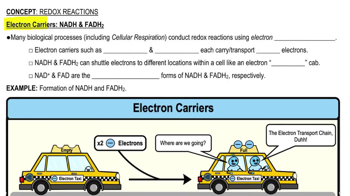
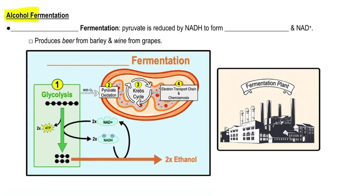
Identify the role of NADH and NAD+ in fermentation: Fermentation involves the conversion of NADH to NAD+ to allow glycolysis to continue.
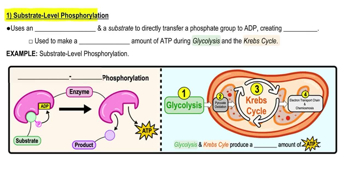
Understand substrate-level phosphorylation: This is a process where ATP is synthesized directly in a metabolic pathway, such as during glycolysis, which is part of fermentation.
Recognize the reduction of NAD+: In fermentation, NAD+ is not reduced to NADH; instead, NADH is oxidized to regenerate NAD+.
Consider the synthesis of electron acceptors: Fermentation does not synthesize new electron acceptors; it regenerates NAD+ to keep glycolysis running.
Evaluate each statement based on the above concepts to determine if they are true or false.
Verified video answer for a similar problem:
This video solution was recommended by our tutors as helpful for the problem above
Video duration:
2m
Play a video:
0 Comments
Key Concepts
Here are the essential concepts you must grasp in order to answer the question correctly.
Fermentation Pathway
The fermentation pathway is a metabolic process that allows cells to generate energy in the absence of oxygen. It involves the conversion of glucose into energy-rich compounds, primarily ATP, through anaerobic processes. This pathway is crucial for organisms that live in oxygen-poor environments and relies on the regeneration of NAD+ to sustain glycolysis.
NADH and NAD+ are coenzymes that play a vital role in cellular metabolism. During fermentation, NADH is oxidized back to NAD+, which is essential for maintaining the flow of glycolysis. This interconversion is critical because it allows the cell to continue producing ATP even when oxygen is not available.
Substrate-level phosphorylation is a method of generating ATP directly from a phosphorylated intermediate during metabolic reactions. In fermentation, this process occurs when a phosphate group is transferred to ADP from a substrate molecule, allowing for ATP synthesis without the need for an electron transport chain, which is typically used in aerobic respiration.

 2:03 minutes
 Verified step by step guidance
 01:59
01:59