Skip to main content
Anatomy & Physiology
My Course
Learn
Exam Prep
AI Tutor
Study Guides
Textbook Solutions
Flashcards
Explore
Try the app
My Course
Learn
Exam Prep
AI Tutor
Study Guides
Textbook Solutions
Flashcards
Explore
Try the app
Back
Activation of T Lymphocytes quiz
You can tap to flip the card.
What types of MHC molecules do dendritic cells possess?
You can tap to flip the card.
👆
What types of MHC molecules do dendritic cells possess?
Dendritic cells possess both MHC class 1 and MHC class 2 molecules.
Track progress
Control buttons has been changed to "navigation" mode.
1/15
Related flashcards
Recommended videos
Activation of T Lymphocytes definitions
Activation of T Lymphocytes
15 Terms
3:29
Comic Strip for T-Cell Activation
943
views
10
rank
7:33
T-Cell Activation
1154
views
13
rank
Terms in this set (15)
Hide definitions
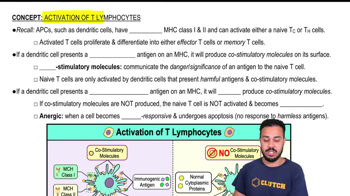
What types of MHC molecules do dendritic cells possess?
Dendritic cells possess both MHC class 1 and MHC class 2 molecules.
Which T cell type is activated by MHC class 1 on dendritic cells?
MHC class 1 activates naive cytotoxic T cells.
Which T cell type is activated by MHC class 2 on dendritic cells?
MHC class 2 activates naive helper T cells.
What happens to T cells after activation by dendritic cells?
Activated T cells proliferate and differentiate into effector T cells or memory T cells.
When do dendritic cells produce co-stimulatory molecules?
Dendritic cells produce co-stimulatory molecules only when presenting harmful antigens.
What is the function of co-stimulatory molecules in T cell activation?
Co-stimulatory molecules signal danger to naive T cells, enhancing their activation.
What is required for naive T cell activation?
Naive T cells require both a harmful antigen and co-stimulatory molecules for activation.
What happens if a dendritic cell presents a harmless antigen?
If a harmless antigen is presented, dendritic cells do not produce co-stimulatory molecules.
What is the fate of naive T cells exposed to harmless antigens without co-stimulatory molecules?
Naive T cells become anergic (unresponsive) and undergo apoptosis.
Why is it important for T cells to become anergic in response to harmless antigens?
This prevents immune responses against harmless antigens, protecting healthy host cells.
What does the term 'anergic' mean in the context of T cells?
Anergic refers to T cells that are unresponsive and do not activate.
What is the outcome for anergic T cells?
Anergic T cells undergo apoptosis, eliminating them from the immune system.
How does the comic strip illustrate T cell activation?
It shows harmful antigens activating T cells, while harmless antigens lead to T cell inactivation.
What immune response is generated when T cells are activated by harmful antigens?
Activated T cells generate an immune response to eliminate the dangerous antigen.
What ensures that the immune system targets only dangerous antigens?
The requirement for co-stimulatory molecules and harmful antigens ensures only dangerous antigens are targeted.
 BackBack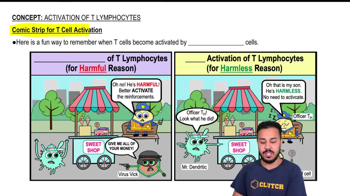
 3:29
3:29