Skip to main content
Anatomy & Physiology
My Course
Learn
Exam Prep
AI Tutor
Study Guides
Textbook Solutions
Flashcards
Explore
Try the app
My Course
Learn
Exam Prep
AI Tutor
Study Guides
Textbook Solutions
Flashcards
Explore
Try the app
Back
Antigens definitions
You can tap to flip the card.
Antigens
You can tap to flip the card.
👆
Antigens
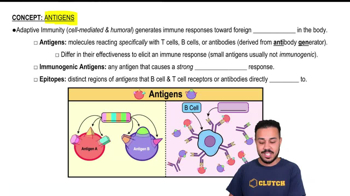
Molecules that specifically react with T cells, B cells, or antibodies, derived from 'antibody generator'.
Track progress
Control buttons has been changed to "navigation" mode.
1/12
Related flashcards
Recommended videos
Antigens quiz
Antigens
12 Terms
4:11
Free Antigens vs. Presented Antigens on APCs
1538
views
16
rank
3:59
Antigens
1731
views
18
rank
Terms in this set (12)
Hide definitions
Antigens
Molecules that specifically react with T cells, B cells, or antibodies, derived from 'antibody generator'.
Adaptive Immunity
A type of immunity that generates responses towards foreign antigens, including cell-mediated and humoral immunity.
Immunogenic
Refers to antigens that elicit a strong immune response.
Epitopes
Distinct regions on antigens that bind directly to B cell receptors, T cell receptors, or antibodies.
B Cell Receptors (BCRs)
Receptors on B cells that bind specifically to epitopes on free antigens.
Free Antigens
Antigens that are free-floating in the environment and not presented by host cells.
Presented Antigens
Antigens processed and presented by antigen presenting cells for T cell activation.
Antigen Presenting Cells (APCs)
Immune cells that process and present antigens, including dendritic cells, macrophages, and B cells.
Dendritic Cells
A type of antigen presenting cell that processes and presents antigens to T cells.
Macrophages
Immune cells that can act as antigen presenting cells, processing and presenting antigens.
T Cells
Immune cells that respond only to antigens presented by antigen presenting cells.
B Cells
Immune cells that respond only to free antigens and can also act as antigen presenting cells.
 BackBack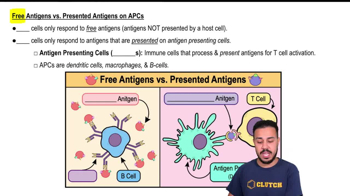
 4:11
4:11