What type of blood vessel covers or surrounds the alveoli in the lungs?
Capillaries are the type of blood vessel that cover and surround the alveoli in the lungs, facilitating gas exchange between the blood and air.
Which blood vessels are responsible for surrounding the alveoli and enabling gas exchange?
Capillaries are the blood vessels that surround the alveoli and enable the exchange of oxygen and carbon dioxide between the blood and lung tissues.
What are the smallest blood vessels in the human body called?
The smallest blood vessels in the human body are called capillaries.
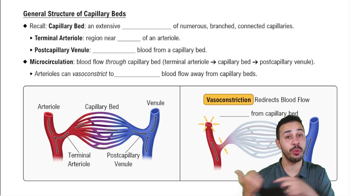
Which type of blood vessel forms extensive networks for nutrient and gas exchange in tissues?
Capillaries form extensive networks known as capillary beds, which are crucial for nutrient and gas exchange between blood and surrounding tissues.
What is the approximate diameter range of capillaries in micrometers?
Capillaries are about 5 to 10 micrometers in diameter. This size is just enough for red blood cells to pass through in a single file line.
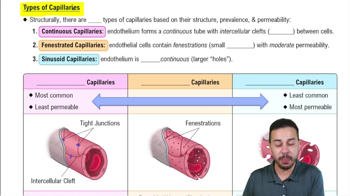
Which structural feature of continuous capillaries makes them the least permeable type?
Continuous capillaries have tightly joined endothelial cells with many tight junctions, forming a continuous tube. This limits the passage of large molecules and makes them the least permeable.
Where in the body are fenestrated capillaries typically found?
Fenestrated capillaries are found in areas of active filtration, secretion, and absorption, such as the kidneys, endocrine glands, and small intestines. Their small pores allow for moderate permeability.
What unique ability do sinusoid capillaries have compared to other capillary types?
Sinusoid capillaries can allow the passage of large molecules and even cells due to their large intercellular clefts and discontinuous endothelium. They are found in organs like the liver, bone marrow, and spleen.
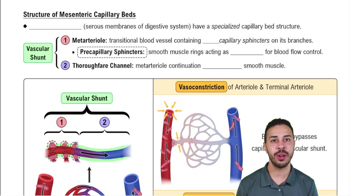
What is the function of precapillary sphincters in mesenteric capillary beds?
Precapillary sphincters are rings of smooth muscle that regulate blood flow into the capillary bed by contracting or relaxing. When they contract, blood is redirected through the vascular shunt, bypassing the capillaries.
How does vasoconstriction of arterioles affect blood flow in capillary beds?
Vasoconstriction of arterioles reduces blood flow into the capillary beds and can redirect blood to other areas of the body where it is needed more. This mechanism helps the body prioritize blood distribution.
 Back
Back

 9:42
9:42