Anatomy & Physiology
My Course
Learn
Exam Prep
AI Tutor
Study Guides
Textbook Solutions
Flashcards
Explore
My Course
Learn
Exam Prep
AI Tutor
Study Guides
Textbook Solutions
Flashcards
Explore
Back
Carbohydrates quiz
You can tap to flip the card.
Which locations represent the largest storage depots for carbohydrates in the body?
You can tap to
flip the card.
👆
Which locations represent the largest storage depots for carbohydrates in the body?
The largest storage depots for carbohydrates in the body are the liver and muscles.
Track progress
Control buttons has been changed to "navigation" mode.
1/10
Related flashcards
Related practice
Recommended videos
Guided course
04:53
Carbohydrates
Bruce Bryan
22627
views
327
rank
Guided course
03:45
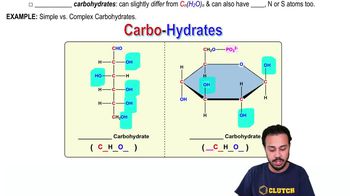
3 Size Classes of Carbohydrates
Bruce Bryan
16927
views
314
rank
Guided course
03:08
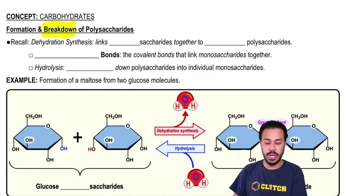
Formation & Breakdown of Polysaccharides
Bruce Bryan
16622
views
250
rank
Terms in this set (10)
Hide definitions
Which locations represent the largest storage depots for carbohydrates in the body?
The largest storage depots for carbohydrates in the body are the liver and muscles.
Which carbohydrate is used to store energy in the liver?
Glycogen is the carbohydrate used to store energy in the liver.
What is the stored form of carbohydrate in the muscles and liver?
The stored form of carbohydrate in the muscles and liver is glycogen.
What is the key to carbohydrate loading before an athletic event?
The key to carbohydrate loading is to increase glycogen stores in the muscles and liver for sustained energy.
Which carbohydrate is used in the liver for energy storage?
Glycogen is used in the liver for energy storage.
Which of the following polysaccharides stores energy in animal muscle tissue? Options: A) Cellulose, B) Starch, C) Glycogen, D) Chitin
C) Glycogen stores energy in animal muscle tissue.
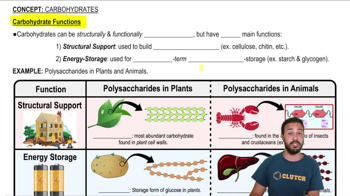
What are the two primary functions of carbohydrates?
The two primary functions of carbohydrates are structural support and energy storage.
What is the most abundant monosaccharide?
Glucose is the most abundant monosaccharide.
What type of reaction is needed to break down polysaccharides into monosaccharides?
A hydrolysis reaction is needed to break down polysaccharides into monosaccharides.
What type of bond links monosaccharides together in polysaccharides?
Glycosidic bonds link monosaccharides together in polysaccharides.