Anatomy & Physiology
My Course
Learn
Exam Prep
AI Tutor
Study Guides
Textbook Solutions
Flashcards
Explore
My Course
Learn
Exam Prep
AI Tutor
Study Guides
Textbook Solutions
Flashcards
Explore
Back
Carbon definitions
You can tap to flip the card.
Carbon
You can tap to
flip the card.
👆
Carbon
The most abundant element in living systems, essential for forming organic molecules.
Track progress
Control buttons has been changed to "navigation" mode.
1/14
Related practice
Recommended videos
Guided course
04:19
Carbon
Bruce Bryan
20778
views
426
rank
Guided course
03:35
Carbon is an Excellent Building Block
Bruce Bryan
15255
views
534
rank
Terms in this set (14)
Hide definitions
Carbon
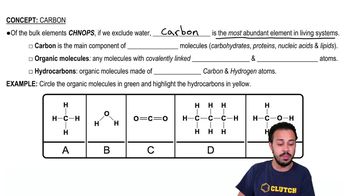
The most abundant element in living systems, essential for forming organic molecules.
Organic molecules
Molecules containing covalently linked carbon and hydrogen atoms.
Hydrocarbons
Organic molecules composed exclusively of carbon and hydrogen atoms.
Carbohydrates
One of the four main classes of organic molecules, primarily composed of carbon, hydrogen, and oxygen.
Proteins
Organic molecules made of amino acids, essential for various biological functions.
Nucleic acids
Organic molecules that store and transmit genetic information, such as DNA and RNA.
Lipids
A class of organic molecules that are hydrophobic and include fats, oils, and steroids.
Covalent bonds
Strong chemical bonds formed by the sharing of electron pairs between atoms.
Carbon backbone
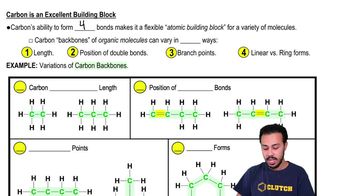
The chain of carbon atoms that forms the structural basis of organic molecules.
Double bonds
Chemical bonds where two pairs of electrons are shared between atoms, affecting molecule shape.
Branch points
Locations in a carbon backbone where a side chain is attached, altering molecule structure.
Ring form
A structural form of carbon backbones where atoms are connected in a closed loop.
Linear form
A structural form of carbon backbones where atoms are arranged in a straight line.
Methane
A simple hydrocarbon consisting of one carbon atom bonded to four hydrogen atoms.