Skip to main content
Anatomy & Physiology
My Course
Learn
Exam Prep
AI Tutor
Study Guides
Textbook Solutions
Flashcards
Explore
Try the app
My Course
Learn
Exam Prep
AI Tutor
Study Guides
Textbook Solutions
Flashcards
Explore
Try the app
Back
Cardiac Cycle definitions
1 student found this helpful
You can tap to flip the card.
Cardiac Cycle
You can tap to flip the card.
👆
Cardiac Cycle
The sequence of events in one heartbeat, including contraction and relaxation of heart chambers.
Track progress
Control buttons has been changed to "navigation" mode.
1/15
Related flashcards
Related practice
Recommended videos
Cardiac Cycle quiz
Cardiac Cycle
24 Terms
Cardiac Cycle quiz #1
Cardiac Cycle
13 Terms
Cardiac Cycle
18. The Heart
7 problems
Topic
Jason
Electrocardiogram (ECG)
18. The Heart
4 problems
Topic
Jason
18. The Heart
4 topics
11 problems
Chapter
Jason
Guided course
3:55
Cardiac Cycle Example 3
3748
views
78
rank
Guided course
3:37
Cardiac Cycle Example 4
3484
views
49
rank
Guided course
6:36
Cardiac Cycle Example 1
5396
views
89
rank
Terms in this set (15)
Hide definitions
Cardiac Cycle
The sequence of events in one heartbeat, including contraction and relaxation of heart chambers.
Systole
The phase of the cardiac cycle where heart chambers contract, increasing pressure to move blood.
Diastole
The phase of the cardiac cycle where heart chambers relax, decreasing pressure for filling.
Atrioventricular Valve
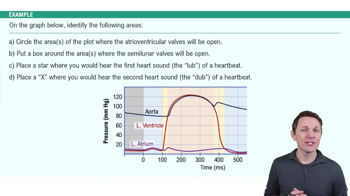
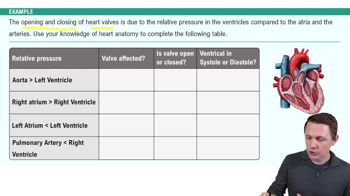
Valves between atria and ventricles that open during diastole and close during systole.
Semilunar Valve
Valves at the exit of ventricles that open during systole and close during diastole.
Ventricular Filling
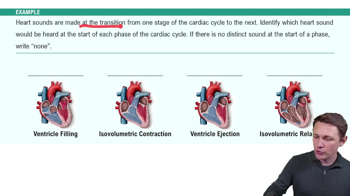
The stage in the cardiac cycle where blood flows from atria to ventricles.
Isovolumetric Contraction
A phase where ventricles contract with no volume change as all valves are closed.
Ventricular Ejection
The phase where blood is pushed from ventricles into the arteries.
Isovolumetric Relaxation
A phase where ventricles relax with no volume change as all valves are closed.
Electrocardiogram (ECG)
A recording of the heart's electrical activity, showing depolarization and repolarization.
Heart Sounds
Sounds produced by the closing of heart valves, known as 'lub' and 'dub'.
Heart Murmur
An abnormal sound indicating turbulent blood flow, often due to valve issues.
Aorta
The main artery carrying blood from the left ventricle to the body.
Pulmonary Trunk
The artery carrying blood from the right ventricle to the lungs.
Depolarization
The process of electrical activation of heart muscle cells, leading to contraction.
 BackBack
 3:55
3:55