Pearson+ LogoPearson+ Logo
Back

Cell Junctions quiz #1

Control buttons has been changed to "navigation" mode.
1/10
  • Which type of muscle cells contain both desmosomes and gap junctions, and what is the function of these junctions?

    Muscle cells, specifically cardiac muscle cells, contain both desmosomes (anchoring junctions) and gap junctions. Desmosomes anchor neighboring cells together, providing structural stability, while gap junctions create protein channels that connect the cytoplasm of adjacent cells, allowing for the exchange of ions and nutrients and enabling coordinated contraction.
  • What is the primary function of tight junctions between animal cells?

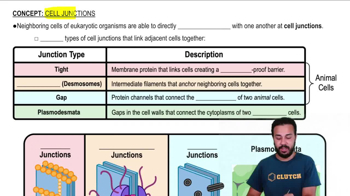
    Tight junctions create leak-proof barriers between adjacent animal cells. This prevents substances like liquids from seeping between the cells.
  • Which cell junction type is responsible for connecting the cytoplasm of two animal cells?

    Gap junctions connect the cytoplasm of two neighboring animal cells. They do this by forming protein channels that allow the exchange of nutrients and other substances.
  • How do anchoring junctions differ from tight junctions in terms of permeability?

    Anchoring junctions are not leak-proof, so substances can seep between cells. In contrast, tight junctions prevent leakage by holding cells tightly together.
  • What are plasmodesmata and in which type of cells are they found?

    Plasmodesmata are gaps in the cell walls that connect the cytoplasm of neighboring plant cells. They are found exclusively in plant cells.
  • Which three types of cell junctions are exclusive to animal cells?

    Tight junctions, anchoring junctions (desmosomes), and gap junctions are exclusive to animal cells. Plasmodesmata are not found in animal cells.
  • What structural feature allows anchoring junctions to link neighboring cells?

    Anchoring junctions use complex protein structures made of intermediate filaments to link neighboring cells. These structures provide mechanical stability.
  • Why are liquids unable to pass between cells with tight junctions?

    Liquids cannot pass between cells with tight junctions because the membrane proteins hold the cells together very tightly. This creates a continuous, impermeable barrier.
  • What is the functional similarity between gap junctions in animal cells and plasmodesmata in plant cells?

    Both gap junctions and plasmodesmata connect the cytoplasm of neighboring cells. This connection allows for the exchange of nutrients and other substances.
  • How do plant cells exchange nutrients with each other through their cell walls?

    Plant cells exchange nutrients through plasmodesmata, which are gaps in their cell walls. These gaps connect the cytoplasm of adjacent plant cells.