Skip to main content
Anatomy & Physiology
My Course
Learn
Exam Prep
AI Tutor
Study Guides
Textbook Solutions
Flashcards
Explore
Try the app
My Course
Learn
Exam Prep
AI Tutor
Study Guides
Textbook Solutions
Flashcards
Explore
Try the app
Back
Cellular Respiration: Types of Phosphorylation definitions
You can tap to flip the card.
ATP
You can tap to flip the card.
👆
ATP
A molecule that stores and transfers energy within cells, produced in large amounts during aerobic cellular respiration.
Track progress
Control buttons has been changed to "navigation" mode.
1/15
Related flashcards
Recommended videos
Cellular Respiration: Types of Phosphorylation quiz
Cellular Respiration: Types of Phosphorylation
15 Terms
02:59
Substrate-Level Phosphorylation
22913
views
360
rank
06:27
Oxidative Phosphorylation
21611
views
279
rank
01:06
Types of Phosphorylation
22501
views
260
rank
Terms in this set (15)
Hide definitions
ATP
A molecule that stores and transfers energy within cells, produced in large amounts during aerobic cellular respiration.
Phosphorylation
A process of adding a phosphate group to a molecule, crucial for ATP production in cellular respiration.
Substrate level Phosphorylation
Direct transfer of a phosphate group to ADP using an enzyme and a substrate, occurring in glycolysis and the Krebs cycle.
Oxidative Phosphorylation
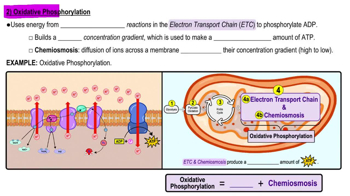
ATP production using energy from redox reactions, involving the electron transport chain and chemiosmosis.
Glycolysis
The first stage of cellular respiration, where glucose is broken down, producing a small amount of ATP.
Krebs Cycle
A series of reactions in cellular respiration that produce ATP and electron carriers, occurring in mitochondria.
Electron Transport Chain
A series of protein complexes that transfer electrons, creating a hydrogen ion gradient for ATP synthesis.
Chemiosmosis
The movement of ions across a membrane, down their gradient, used to drive ATP synthesis in cells.
Redox Reactions
Chemical reactions involving the transfer of electrons, crucial for energy production in oxidative phosphorylation.
Hydrogen Ion Gradient
A difference in hydrogen ion concentration across a membrane, used to generate ATP in chemiosmosis.
ADP
A molecule that is converted to ATP by the addition of a phosphate group during cellular respiration.
Aerobic Cellular Respiration
A process that uses oxygen to convert glucose into ATP, involving glycolysis, the Krebs cycle, and oxidative phosphorylation.
Enzyme
A protein that catalyzes chemical reactions, such as the transfer of phosphate groups in substrate level phosphorylation.
Substrate
A molecule upon which an enzyme acts, providing a phosphate group in substrate level phosphorylation.
Mitochondria
Organelles where the Krebs cycle and oxidative phosphorylation occur, producing ATP for the cell.
 BackBack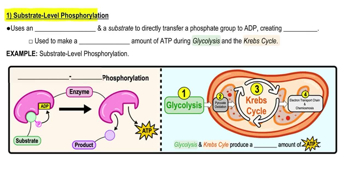
 02:59
02:59