Skip to main content
Anatomy & Physiology
My Course
Learn
Exam Prep
AI Tutor
Study Guides
Textbook Solutions
Flashcards
Explore
Try the app
My Course
Learn
Exam Prep
AI Tutor
Study Guides
Textbook Solutions
Flashcards
Explore
Try the app
Back
Classes of Antibodies definitions
You can tap to flip the card.
Immunoglobulins
You can tap to flip the card.
👆
Immunoglobulins
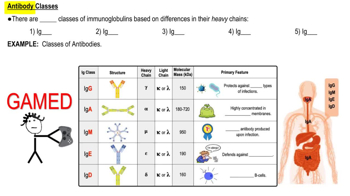
Proteins that function as antibodies, classified into five main types: IgG, IgA, IgM, IgE, and IgD.
Track progress
Control buttons has been changed to "navigation" mode.
1/15
Related flashcards
Recommended videos
Classes of Antibodies quiz
Classes of Antibodies
23 Terms
Classes of Antibodies quiz #1
Classes of Antibodies
10 Terms
2:44
IgA
1139
views
11
rank
4:43
Classes of Antibodies
1252
views
19
rank
3:34
IgM
1093
views
10
rank
Terms in this set (15)
Hide definitions
Immunoglobulins
Proteins that function as antibodies, classified into five main types: IgG, IgA, IgM, IgE, and IgD.
IgG
The most abundant antibody, providing immunity to fetuses and newborns by crossing the placenta.
IgA
Antibody that protects mucous membranes, found in secretions like saliva and breast milk.
IgM
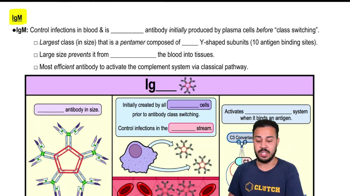
The first antibody produced during an infection, effective in blood, and forms a pentamer.
IgE
Antibody involved in allergic reactions and parasite defense, found on basophils and mast cells.
IgD
Antibody that plays a role in B cell activation and maturation into plasma cells.
Heavy chain
The component of an antibody that distinguishes different classes of immunoglobulins.
Light chain
A component of antibodies that is identical across all classes and does not distinguish them.
Dimer
A structure formed by two identical subunits, as seen in IgA antibodies.
Pentamer
A structure formed by five identical subunits, characteristic of IgM antibodies.
Complement system
A part of the immune system activated by antibodies like IgG and IgM to eliminate pathogens.
Degranulation
The release of granule contents from cells like mast cells, triggered by IgE antibodies.
Basophils
White blood cells that circulate in the bloodstream and interact with IgE antibodies.
Mast cells
Cells found in tissues that release inflammatory mediators upon interaction with IgE.
Plasma cells
Cells that secrete antibodies, developed from B cells activated by IgD antibodies.
 BackBack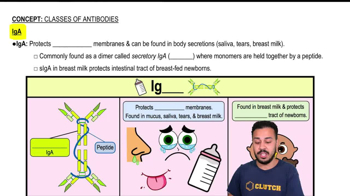
 2:44
2:44