Skip to main content
Anatomy & Physiology
My Course
Learn
Exam Prep
AI Tutor
Study Guides
Textbook Solutions
Flashcards
Explore
Try the app
My Course
Learn
Exam Prep
AI Tutor
Study Guides
Textbook Solutions
Flashcards
Explore
Try the app
Back
Control of the ANS definitions
You can tap to flip the card.
Hypothalamus
You can tap to flip the card.
👆
Hypothalamus
Central brain structure controlling autonomic functions like heart rate and digestion, directing parasympathetic and sympathetic activities.
Track progress
Control buttons has been changed to "navigation" mode.
1/15
Related flashcards
Related practice
Recommended videos
Control of the ANS quiz
Control of the ANS
10 Terms
Control of the ANS quiz #1
Control of the ANS
10 Terms
Control of the ANS
14. The Autonomic Nervous System
1 problem
Topic
Sympathetic Nervous System
14. The Autonomic Nervous System
7 problems
Topic
Jason
14. The Autonomic Nervous System
6 topics
13 problems
Chapter
Jason
0:45
Control of the ANS Example 1
5199
views
95
rank
2:05
Control of the ANS Example 2
4833
views
77
rank
3:33
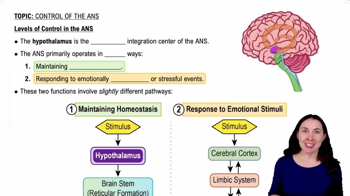
Levels of Control in the ANS
5897
views
86
rank
Terms in this set (15)
Hide definitions
Hypothalamus
Central brain structure controlling autonomic functions like heart rate and digestion, directing parasympathetic and sympathetic activities.
Parasympathetic activity
Part of the autonomic nervous system responsible for maintaining homeostasis, often associated with rest and digestion.
Sympathetic activity
Part of the autonomic nervous system that prepares the body for stress-related activities, often linked to fight or flight responses.
Brainstem
Acts as a relay center between the brain and spinal cord, containing nuclei that help control autonomic functions.
Reticular formation
Network of neurons and nuclei regulating skeletal and visceral muscle activity, influencing autonomic functions.
Limbic system
Group of brain structures involved in processing emotional stimuli and memory, including the thalamus and amygdala.
Amygdala
Part of the limbic system involved in processing emotions, particularly fear and threat-related stimuli.
Hippocampus
Brain structure involved in storing long-term and emotional memories, part of the limbic system.
Homeostasis
The body's process of maintaining a stable internal environment, largely managed by parasympathetic activity.
Efferent pathway
Nerve pathway that carries commands from the central nervous system to effector organs.
Prefrontal cortex
Brain region involved in conscious processing of emotions and decision-making during stress responses.
Fight or flight
Physiological response to perceived threats, activating sympathetic nervous system to prepare for action.
Cerebral cortex
Outer layer of the brain involved in complex functions like perception, thought, and decision-making.
Nuclei
Clusters of neurons in the brainstem that help regulate autonomic functions.
Visceral muscle
Muscle tissue associated with internal organs, regulated by the autonomic nervous system.
 BackBack
 0:45
0:45