Pearson+ LogoPearson+ Logo
Back

Control of the ANS quiz #1

Control buttons has been changed to "navigation" mode.
1/10
  • Which part of the brain is primarily responsible for controlling heart rate through the autonomic nervous system?

    The hypothalamus is the main brain structure responsible for controlling heart rate via the autonomic nervous system, acting as the command center for autonomic functions such as heart rate, blood pressure, and digestion.
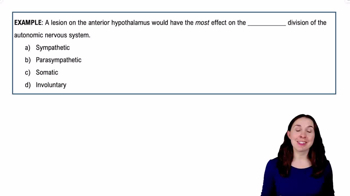
  • What role does the anterior hypothalamus play in autonomic nervous system activity?

    The anterior hypothalamus primarily directs parasympathetic activity. This means it is involved in calming and restorative functions of the body.
  • How does the posterior hypothalamus contribute to autonomic responses?

    The posterior hypothalamus largely directs sympathetic activity. This region is responsible for activating the body's stress or fight-or-flight responses.
  • What is the main function of the brainstem in autonomic nervous system control?

    The brainstem acts as a relay center between the brain, spinal cord, and body. It contains nuclei that help control autonomic functions.
  • Which brain structure has the most direct influence on autonomic functions and is less active during parasympathetic activation?

    The reticular formation has the most direct influence on autonomic functions. It becomes less active when the parasympathetic system is dominant.
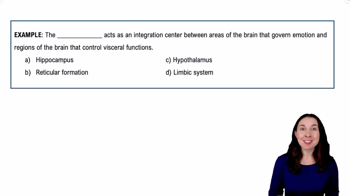
  • What components make up the limbic system relevant to autonomic control?

    The limbic system includes the thalamus, hypothalamus, amygdala, and hippocampus. These structures are important for processing emotional stimuli and memory.
  • How does the limbic system contribute to the processing of emotionally salient stimuli?

    The limbic system helps process and interpret emotional stimuli. It allows the brain to recall memories and emotions associated with a stimulus.
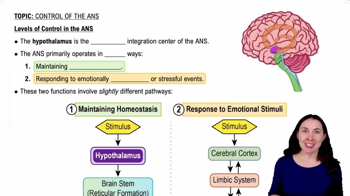
  • What is the sequence of neural structures involved in maintaining homeostasis via the ANS?

    Stimuli are processed by the hypothalamus, which sends commands to the brainstem and reticular formation, then to the spinal cord, and finally to effector organs. This pathway is primarily involved in parasympathetic responses.
  • How does the brain process a threatening stimulus before activating the fight-or-flight response?

    The amygdala processes fear, the hippocampus recalls related memories, and the prefrontal cortex evaluates the situation. This information is sent to the hypothalamus, which decides whether to activate the fight-or-flight response.
  • What feedback loop can occur between physical sensations and emotional processing during fear responses?

    Physical sensations like a pounding heart can enhance cognitive perceptions of fear. This creates a feedback loop between the hypothalamus, limbic system, and cerebral cortex.