What represents ventricular depolarization on an ECG?
QRS complex
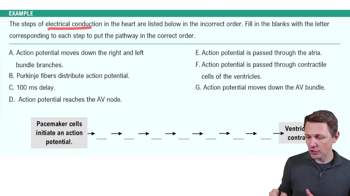
What is the correct sequence of components of the cardiac conduction system?
The correct sequence is SA node, AV node, bundle of His, right and left bundle branches, Purkinje fibers.
What is the sequence of events in the transmission of an impulse through the heart muscle?
The sequence is SA node activation, atrial contraction, AV node delay, ventricular contraction.
What is the sequence of travel by an impulse through the cardiac conduction system?
The impulse travels from the SA node to the AV node, then to the bundle of His, bundle branches, and Purkinje fibers.
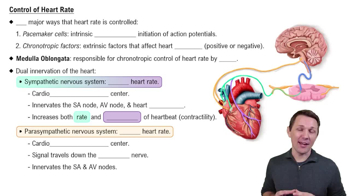
What establishes the rhythm and rate of the heartbeat?
The SA node establishes the rhythm and rate of the heartbeat.
What is a valid teaching point for a client with cardiomyopathy?
Cardiomyopathy can affect the heart's ability to pump blood effectively.
Which events occur at the beginning of ventricular systole?
At the beginning of ventricular systole, the ventricles contract, and the AV valves close.
Why is the QRS complex larger than the P wave?
The QRS complex is larger because it represents the depolarization of the larger muscle mass of the ventricles compared to the atria.
Which cardiac events do the P wave represent?
The P wave represents atrial depolarization.
In which situation should synchronized cardioversion be used? A) Atrial fibrillation B) Ventricular fibrillation C) Asystole D) Bradycardia
A) Atrial fibrillation
Can the heart beat independently of the nervous system?
It can beat independently of the nervous system
The heart contracts because of an electrical impulse. Where in the heart does this impulse start?
The electrical impulse starts in the SA node.
Where is the heartbeat initiated?
The heartbeat is initiated in the SA node.
How can the heart rate be calculated using the QRS complexes?
Heart rate can be calculated by counting the number of QRS complexes in a given time frame and converting to beats per minute.
What sequence describes the flow of electrical impulses in the heart?
The sequence is SA node, AV node, bundle of His, bundle branches, Purkinje fibers.
What is the correct sequence of electrical conduction of the heart?
The correct sequence is SA node, AV node, bundle of His, right and left bundle branches, Purkinje fibers.
What is the formula for calculating cardiac output?
Cardiac output is calculated as heart rate multiplied by stroke volume.
What ensures the movement of blood in one direction through the heart?
Heart valves ensure the movement of blood in one direction through the heart.
Which chambers contract simultaneously?
The right and left atria contract simultaneously, followed by the right and left ventricles.
How does the cardiac muscle receive its supply of oxygenated blood?
Coronary arteries
What causes the semilunar valves to open during the cardiac cycle?
The semilunar valves open when ventricular pressure exceeds the pressure in the arteries.
Which structure within the heart’s conduction system is known as the “pacemaker of the heart”?
The SA node is known as the “pacemaker of the heart.”
Which structure in the heart functions as the natural pacemaker?
The SA node functions as the natural pacemaker.
What is happening in the heart as the semilunar valves are closing?
As the semilunar valves are closing, the ventricles are relaxing, and the heart is entering diastole.
Which electrical activity of the cardiac conduction system is reflected in the P wave?
The P wave reflects atrial depolarization.
Where in the heart is the sinoatrial node located?
The sinoatrial node is located in the superior right atrial wall.
What are the conduction fibers found between the SA and AV nodes called?
The conduction fibers between the SA and AV nodes are called internodal pathways.
What is the primary pacemaker of the heart?
SA node
What normally serves as the pacemaker of the entire heart?
The SA node normally serves as the pacemaker of the entire heart.
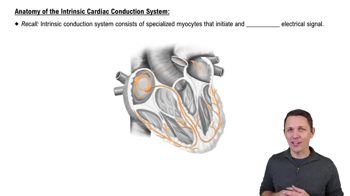
What is the primary function of the intrinsic cardiac conduction system, and how does it differ from the way skeletal muscle contracts?
The intrinsic cardiac conduction system initiates and conducts action potentials within the heart, enabling coordinated and regular heartbeats without neural input. Unlike skeletal muscle, which requires neural stimulation for contraction, cardiac muscle cells can generate and propagate action potentials autonomously.
How do gap junctions and conducting fibers contribute to the coordinated contraction of the heart muscle?
Gap junctions allow action potentials to rapidly spread from cell to cell, enabling synchronized contraction of heart chambers. Conducting fibers, which are specialized for fast signal transmission, ensure that action potentials reach different parts of the heart quickly and efficiently, further supporting coordinated contractions.
 Back
Back
 6:13
6:13