Anatomy & Physiology
My Course
Learn
Exam Prep
AI Tutor
Study Guides
Textbook Solutions
Flashcards
Explore
My Course
Learn
Exam Prep
AI Tutor
Study Guides
Textbook Solutions
Flashcards
Explore
Back
Introduction to Membrane Transport definitions
You can tap to flip the card.
Biological Membranes
You can tap to
flip the card.
👆
Biological Membranes
Structures that are selectively permeable, allowing certain molecules to cross based on size, charge, and polarity.
Track progress
Control buttons has been changed to "navigation" mode.
1/15
Related flashcards
Related practice
Recommended videos
Guided course
03:00
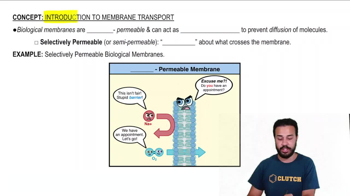
Introduction to Membrane Transport
Bruce Bryan
17193
views
274
rank
Guided course
07:10
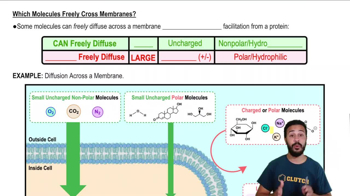
Which Molecules Freely Cross Membranes?
Bruce Bryan
15448
views
227
rank
Guided course
02:26
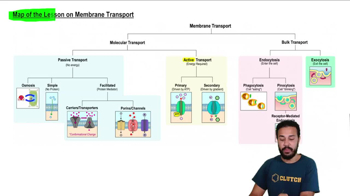
Map of the Lesson on Membrane Transport
Bruce Bryan
13387
views
167
rank
Terms in this set (15)
Hide definitions
Biological Membranes
Structures that are selectively permeable, allowing certain molecules to cross based on size, charge, and polarity.
Selectively Permeable
Characteristic of membranes that allows selective passage of substances while blocking others.
Passive Transport
Movement of molecules across membranes without energy input, including osmosis and diffusion.
Active Transport
Energy-requiring process that moves molecules across a membrane against a concentration gradient.
Osmosis
Passive transport of water molecules across a selectively permeable membrane.
Simple Diffusion
Movement of small, nonpolar molecules across a membrane without assistance.
Facilitated Diffusion
Passive transport of molecules across a membrane via specific transport proteins.
Endocytosis
Bulk transport process where cells engulf external substances into vesicles.
Exocytosis
Process by which cells expel materials in vesicles to the extracellular environment.
Phagocytosis
Type of endocytosis where cells ingest large particles or cells, often called 'cell eating.'
Pinocytosis
Type of endocytosis where cells ingest extracellular fluid, often called 'cell drinking.'
Receptor-mediated Endocytosis
Selective uptake of molecules into a cell via receptor binding and vesicle formation.
Hydrophobic
Describes molecules that repel water and are typically nonpolar.
Hydrophilic
Describes molecules that attract water and are typically polar.
Macromolecules
Large complex molecules such as proteins, nucleic acids, and polysaccharides.