Skip to main content
Anatomy & Physiology
My Course
Learn
Exam Prep
AI Tutor
Study Guides
Textbook Solutions
Flashcards
Explore
Try the app
My Course
Learn
Exam Prep
AI Tutor
Study Guides
Textbook Solutions
Flashcards
Explore
Try the app
Back
Introduction to Muscles and Muscle Tissue definitions
5 students found this helpful
You can tap to flip the card.
Contractility
You can tap to flip the card.
👆
Contractility
The ability of muscle tissue to shorten forcibly, generating movement.
Track progress
Control buttons has been changed to "navigation" mode.
1/15
Related flashcards
Related practice
Recommended videos
Introduction to Muscles and Muscle Tissue quiz #1
Introduction to Muscles and Muscle Tissue
39 Terms
Introduction to Muscles and Muscle Tissue quiz #2
Introduction to Muscles and Muscle Tissue
37 Terms
Introduction to Muscles and Muscle Tissue quiz #3
Introduction to Muscles and Muscle Tissue
40 Terms
Introduction to Muscles and Muscle Tissue
9. Muscle Tissue
7 problems
Topic
Bruce
Structure of a Skeletal Muscle
9. Muscle Tissue
7 problems
Topic
Jason
9. Muscle Tissue
4 topics
11 problems
Chapter
Jason
Guided course
6:31
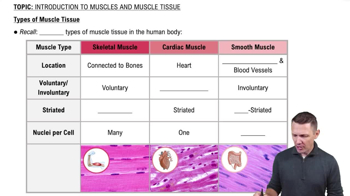
Types of Muscle Tissue
15312
views
421
rank
1
comments
Guided course
2:00
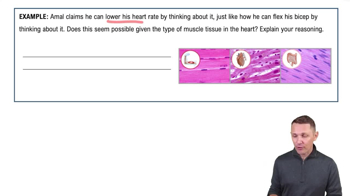
Introduction to Muscles and Muscle Tissue Example 1
12589
views
264
rank
Guided course
4:36
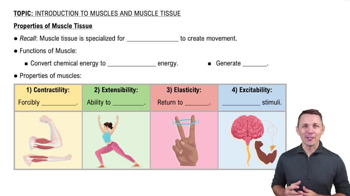
Properties of Muscle Tissue
21062
views
603
rank
2
comments
Terms in this set (15)
Hide definitions
Contractility
The ability of muscle tissue to shorten forcibly, generating movement.
Extensibility
The capacity of muscle tissue to be stretched without damage.
Elasticity
The property of muscle tissue to return to its original shape after contraction or extension.
Excitability
The ability of muscle tissue to respond to stimuli, often through action potentials.
Skeletal Muscle
Voluntary, striated muscle tissue attached to bones, responsible for body movement.
Cardiac Muscle
Involuntary, striated muscle found in the heart, characterized by a branching pattern.
Smooth Muscle
Involuntary, non-striated muscle found in hollow organs, controlling movement within them.
Striations
Crosswise stripes in muscle tissue indicating organized protein structures.
Intercalated Discs
Structures in cardiac muscle linking cells, facilitating synchronized contraction.
ATP
The primary energy carrier in cells, used by muscles to convert chemical energy into movement.
Nuclei
Cellular structures containing genetic material; skeletal muscle cells have multiple due to their size.
Voluntary Muscle
Muscle that can be consciously controlled, such as skeletal muscle.
Involuntary Muscle
Muscle that operates without conscious control, like cardiac and smooth muscle.
Mechanical Energy
Energy associated with the movement and position of an object, produced by muscle contraction.
Homeostasis
The body's ability to maintain stable internal conditions, aided by muscle-generated heat.
 BackBack

 6:31
6:31