Back

Introduction to Sensory Receptors quiz #3

Control buttons has been changed to "navigation" mode.
1/38
  • Where are receptors for the special senses located?

    Receptors for the special senses are located in specific organs, such as the eyes, ears, nose, and tongue.
  • Which body part regulates balance?

    The inner ear, specifically the vestibular apparatus, regulates balance.
  • What type of sensory receptor is a hair cell?

    A hair cell is a mechanoreceptor.
  • Which sensory cells respond to light touch?

    Meissner's corpuscles are sensory cells that respond to light touch.
  • Which of the receptor types contributes to the sense of touch by responding to light pressure?

    Merkel cells contribute to the sense of touch by responding to light pressure.
  • Which two of the following senses use chemoreceptors? Options: Vision, Hearing, Taste, Smell

    Taste, Smell
  • What are the characteristics of peripheral vision?

    Peripheral vision is less detailed than central vision but is important for detecting motion and providing a wide field of view.
  • Which two are divisions of the sensory nervous system? Options: Somatic sensory, Autonomic sensory, Visceral sensory, Motor sensory

    Somatic sensory, Visceral sensory
  • What is a skin sensory receptor for touch?

    Meissner's corpuscles are skin sensory receptors for touch.
  • Which receptors respond to stimuli within the body?

    Interoceptors respond to stimuli within the body.
  • What type of stimuli do exteroceptors respond to?

    External stimuli
  • The bending of which structures leads to the nerve signals that are interpreted as sound?

    The bending of hair cells in the cochlea leads to nerve signals that are interpreted as sound.
  • Where are visceroceptors located?

    Internal organs
  • Which type of receptor is specialized to respond to hot and cold stimuli?

    Thermoreceptors are specialized to respond to hot and cold stimuli.
  • Which type of sensory receptor enables you to see?

    Photoreceptors enable you to see.
  • Which of these mechanoreceptors detect deep vibration?

    Pacinian corpuscles detect deep vibration.
  • What correctly describes olfactory receptors?

    Olfactory receptors are chemoreceptors located in the nasal cavity that detect airborne chemicals.
  • Where are receptors located?

    Receptors are located throughout the body, including the skin, eyes, ears, nose, and tongue.
  • What is sensory transduction?

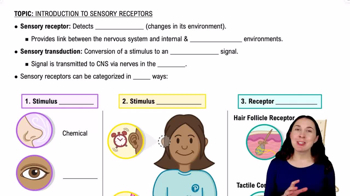
    Sensory transduction is the process of converting a stimulus into an electrical signal for neuron communication.
  • What are gustatory receptors and what do they detect?

    Gustatory receptors are chemoreceptors located in taste buds that detect chemicals in food.
  • What is the function of the sensory receptors?

    The function of sensory receptors is to detect stimuli and convert them into electrical signals for the nervous system.
  • Tactile cells are receptors for which sensation?

    Touch
  • The utricle is especially sensitive to what type of movements?

    The utricle is especially sensitive to linear accelerations and head tilts in the horizontal plane.
  • Which body part regulates the body's ability to balance?

    The inner ear, specifically the vestibular apparatus, regulates the body's ability to balance.
  • Which nervous system division is responsible for the integration of sensory information?

    The central nervous system is responsible for the integration of sensory information.
  • What are papillae and where are they located?

    Papillae are small projections on the tongue that contain taste buds.
  • The nurse should consider which client aspect as nonverbal communication?

    The nurse should consider body language, facial expressions, and gestures as nonverbal communication.
  • Where are the sensory receptors for smell located?

    The sensory receptors for smell are located in the olfactory epithelium of the nasal cavity.
  • How do sensory receptors respond to stimuli?

    Sensory receptors respond to stimuli by converting them into electrical signals that are transmitted to the nervous system.
  • How is the strength of a stimulus encoded by neurons?

    The strength of a stimulus is encoded by the frequency of action potentials and the number of activated receptors.
  • How does the input of olfactory information to the brain differ from other sensory input pathways?

    Olfactory information bypasses the thalamus and goes directly to the olfactory cortex.
  • Which receptor detects pressure changes?

    Baroreceptors detect pressure changes.
  • Which receptor is responsible for detecting stimuli of a special sense?

    Photoreceptor
  • How do we sense hot if we don’t have hot receptors?

    We sense hot through the activation of thermoreceptors that respond to temperature changes.
  • What is the role of the sensory division?

    The role of the sensory division is to transmit sensory information from receptors to the central nervous system.
  • Which type of receptor alerts the brain that the body has been damaged?

    Nociceptors alert the brain that the body has been damaged.
  • Which senses use chemoreceptors?

    Taste, Smell
  • What is responsible for sharpening contrast at visual borders?

    Lateral inhibition is responsible for sharpening contrast at visual borders.