Skip to main content
Anatomy & Physiology
My Course
Learn
Exam Prep
AI Tutor
Study Guides
Textbook Solutions
Flashcards
Explore
Try the app
My Course
Learn
Exam Prep
AI Tutor
Study Guides
Textbook Solutions
Flashcards
Explore
Try the app
Back
Introduction to the Digestive System quiz #3
You can tap to flip the card.
What conditions can cause megacolon?
You can tap to flip the card.
👆
What conditions can cause megacolon?
a) Hirschsprung's disease, b) Chronic constipation
Track progress
Control buttons has been changed to "navigation" mode.
1/36
Related flashcards
Related practice
Recommended videos
Introduction to the Digestive System definitions
Introduction to the Digestive System
15 Terms
Introduction to the Digestive System quiz #1
Introduction to the Digestive System
40 Terms
Introduction to the Digestive System quiz #2
Introduction to the Digestive System
37 Terms
Introduction to the Digestive System
23. The Digestive System
5 problems
Topic
Jason
The Stomach
23. The Digestive System
5 problems
Topic
Jason
23. The Digestive System - Part 1 of 2
4 topics
11 problems
Chapter
Jason
23. The Digestive System - Part 2 of 2
2 topics
5 problems
Chapter
Guided course
4:06
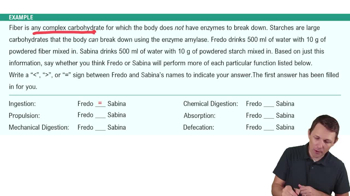
Introduction to the Digestive System Example 2
4855
views
92
rank
Guided course
5:08
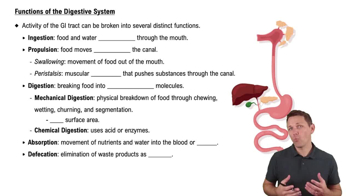
Functions of the Digestive System
6086
views
130
rank
Guided course
6:28
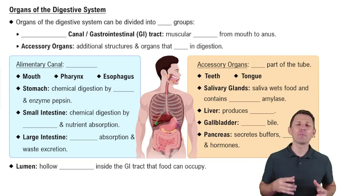
Organs of the Digestive System
9365
views
273
rank
1
comments
Terms in this set (36)
Hide definitions
What conditions can cause megacolon?
a) Hirschsprung's disease, b) Chronic constipation
Which part of the digestive system has villi?
The small intestine has villi.
What is a function of the digestive system?
Absorption
Where is the main place for fiber digestion in horses?
The cecum is the main place for fiber digestion in horses.
Which is not an accessory organ or gland of the digestive system? a) Liver b) Pancreas c) Gallbladder d) Esophagus
d) Esophagus
How do the digestive and circulatory systems work together?
The digestive system breaks down food into nutrients, which are then absorbed into the bloodstream by the circulatory system.
Which enzyme breaks down protein-forming polypeptides in the stomach?
Pepsin breaks down protein-forming polypeptides in the stomach.
Which drug form should not be administered orally?
Injections
What is the function of the pancreatic enzyme trypsin?
Trypsin is an enzyme that digests proteins in the small intestine.
Which layer of the digestive tract secretes a fluid that reduces friction with other organs?
The serosa layer of the digestive tract secretes a fluid that reduces friction with other organs.
Which client statement indicates a need for further instruction about a duodenal ulcer?
A statement indicating that spicy foods cause ulcers would indicate a need for further instruction.
What is an advantage of a complete digestive system?
A complete digestive system allows for more efficient digestion and absorption of nutrients.
What body systems are related to taking in nutrients and expelling them from the body?
The digestive and excretory systems are related to taking in nutrients and expelling waste from the body.
What is a correct statement about fiber in the digestive system?
Fiber aids in digestion by adding bulk to stool and promoting regular bowel movements.
Which organ is not an accessory organ of digestion?
Esophagus
What cell produces pepsinogen?
Chief cells in the stomach produce pepsinogen.
How well do you think your system will digest food? Explain your reasoning.
This is subjective and depends on individual health, diet, and digestive efficiency.
Immediately after chylomicrons leave the intestinal cells, where do they go?
Chylomicrons enter the lymphatic system before reaching the bloodstream.
Which layer of the digestive tract contains blood vessels and nerve cells?
The submucosa layer contains blood vessels and nerve cells.
Which substance is not a component of bile?
Amylase
Which two body systems are primarily responsible for breaking down food and removing waste?
The digestive and excretory systems are primarily responsible for breaking down food and removing waste.
After chylomicrons leave the intestinal cells, what is their next destination?
Chylomicrons enter the lymphatic system before reaching the bloodstream.
What is true about the function of bile?
Bile aids in the emulsification of fats, making them easier to digest.
Which organ produces a chemical necessary for fat emulsification?
The liver produces bile, which is necessary for fat emulsification.
Which vitamin is absorbed in the ileum after binding to intrinsic factor?
Vitamin B12 is absorbed in the ileum after binding to intrinsic factor.
Which of these enzymes digests proteins in the small intestine?
Trypsin digests proteins in the small intestine.
Which organ is considered an accessory organ of the digestive system?
Liver
Why are the muscles that move food through your digestive tract called involuntary muscles?
They are called involuntary muscles because their movement is not under conscious control.
The nurse instructs the client on which activity that would minimize risk for constipation?
The nurse instructs the client to increase fiber intake and stay hydrated to minimize the risk for constipation.
Which digestive system organ is the target of gastrin?
The stomach is the target of gastrin.
What is the outermost layer of the gastrointestinal tract wall?
The outermost layer of the gastrointestinal tract wall is the serosa.
During digestion, what is the role of the villi?
The villi increase the surface area for absorption of nutrients in the small intestine.
What regulates the release of pancreatic digestive secretions?
Hormones such as secretin and cholecystokinin regulate the release of pancreatic digestive secretions.
What are the functions of the digestive system?
Ingestion, Digestion, Absorption
What is the primary cause of peptic ulcers?
The primary cause of peptic ulcers is infection with Helicobacter pylori bacteria.
Which organ is an accessory organ of digestion?
Liver
 BackBack
 4:06
4:06