Skip to main content
Anatomy & Physiology
My Course
Learn
Exam Prep
AI Tutor
Study Guides
Textbook Solutions
Flashcards
Explore
Try the app
My Course
Learn
Exam Prep
AI Tutor
Study Guides
Textbook Solutions
Flashcards
Explore
Try the app
Back
Law of Partial Pressure definitions
1 student found this helpful
You can tap to flip the card.
Respiration
You can tap to flip the card.
👆
Respiration
The process involving the movement of oxygen and carbon dioxide in and out of the blood driven by pressure gradients.
Track progress
Control buttons has been changed to "navigation" mode.
1/15
Related flashcards
Recommended videos
Law of Partial Pressure quiz #1
Law of Partial Pressure
10 Terms
Guided course
6:12
Partial Pressure
3766
views
53
rank
Guided course
5:51
Pressures: Dalton’s and Henry’s Laws
3354
views
57
rank
Guided course
3:18
Law of Partial Pressure Example 1
2951
views
45
rank
Terms in this set (15)
Hide definitions
Respiration
The process involving the movement of oxygen and carbon dioxide in and out of the blood driven by pressure gradients.
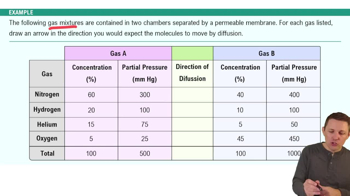
Partial Pressure
The pressure exerted by a single type of gas in a mixture of gases, crucial for understanding gas diffusion.
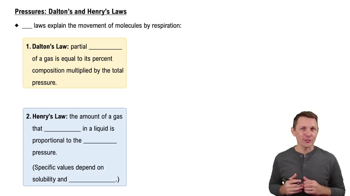
Dalton's Law
States that the total pressure of a gas mixture is the sum of the partial pressures of each individual gas.
Henry's Law
Indicates that the amount of gas dissolved in a liquid is proportional to its partial pressure.
Pressure Gradient
The difference in pressure that drives the passive movement of gases across membranes.
Atmospheric Pressure
The pressure exerted by the weight of the atmosphere, typically 760 mmHg at sea level.
Nitrogen
A major component of atmospheric air, making up about 78% of it, with a significant partial pressure.
Oxygen
A vital gas for respiration, constituting about 21% of atmospheric air, with a notable partial pressure.
Carbon Dioxide
A trace gas in the atmosphere, crucial for respiration, with a very low partial pressure.
Argon
An inert gas making up about 1% of the atmosphere, not significant in physiological processes.
Solubility
The ability of a gas to dissolve in a liquid, influenced by its partial pressure and other factors.
Sea Level
The reference point for atmospheric pressure, where it is typically 760 mmHg.
Altitude
The height above sea level, affecting atmospheric pressure and gas solubility.
Homeostasis
The body's ability to maintain a stable internal environment, including constant temperature.
Ventilation
The process of moving air in and out of the lungs, facilitating gas exchange.
 BackBack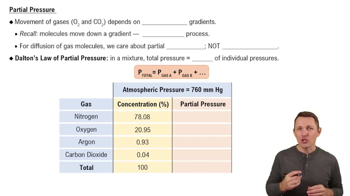
 6:12
6:12