Anatomy & Physiology
My Course
Learn
Exam Prep
AI Tutor
Study Guides
Textbook Solutions
Flashcards
Explore
My Course
Learn
Exam Prep
AI Tutor
Study Guides
Textbook Solutions
Flashcards
Explore
Back
Lipids definitions
You can tap to flip the card.
Lipids
You can tap to
flip the card.
👆
Lipids
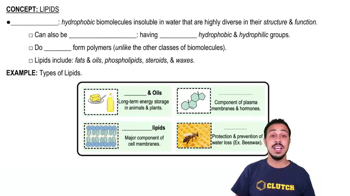
Diverse hydrophobic biomolecules that do not form polymers, including fats, oils, phospholipids, steroids, and waxes.
Track progress
Control buttons has been changed to "navigation" mode.
1/15
Related flashcards
Related practice
Recommended videos
Guided course
04:19
Lipids
Bruce Bryan
17281
views
269
rank
Guided course
06:59
Fatty Acids
Bruce Bryan
14377
views
217
rank
Guided course
03:48
Triglycerides
Bruce Bryan
13303
views
162
rank
Terms in this set (15)
Hide definitions
Lipids
Diverse hydrophobic biomolecules that do not form polymers, including fats, oils, phospholipids, steroids, and waxes.
Fatty acids
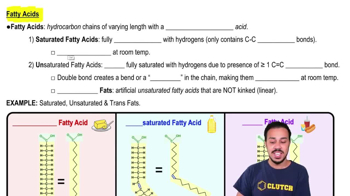
Hydrocarbon chains with a carboxylic acid group; can be saturated or unsaturated.
Saturated fatty acids
Fatty acids fully saturated with hydrogens, containing only single bonds, solid at room temperature.
Unsaturated fatty acids
Fatty acids with one or more double bonds, causing kinks, liquid at room temperature.
Trans fatty acids
Artificial unsaturated fatty acids with a double bond but no kink, often found in processed foods.
Triglycerides
Lipids formed by three fatty acids linked to a glycerol molecule, primary fat storage in animals.
Glycerol
A three-carbon molecule that forms the backbone of triglycerides and phospholipids.
Phospholipids
Amphipathic lipids with a phosphate group, major component of cell membranes.
Amphipathic
Molecules containing both hydrophilic and hydrophobic groups.
Steroids
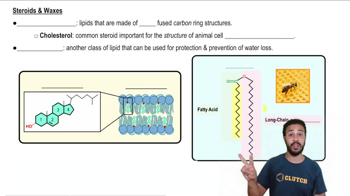
Lipids with four fused carbon rings, important for cell membrane structure and as hormones.
Cholesterol
A steroid crucial for animal cell membrane structure, composed of four fused carbon rings.
Waxes
Lipids composed of long-chain alcohols and fatty acids, used for protection and water loss prevention.
Hydrophobic
Describes molecules that are water-fearing and do not mix well with water.
Hydrophilic
Describes molecules that are water-loving and interact well with water.
Dehydration synthesis
A chemical reaction that builds molecules by removing water, used in forming triglycerides.