Skip to main content
Anatomy & Physiology
My Course
Learn
Exam Prep
AI Tutor
Study Guides
Textbook Solutions
Flashcards
Explore
Try the app
My Course
Learn
Exam Prep
AI Tutor
Study Guides
Textbook Solutions
Flashcards
Explore
Try the app
Back
Lymphatic Vasculature definitions
1 student found this helpful
You can tap to flip the card.
Lymphatic Capillaries
You can tap to flip the card.
👆
Lymphatic Capillaries
Smallest and most numerous vessels, absorb interstitial fluid and proteins, initiating lymph formation.
Track progress
Control buttons has been changed to "navigation" mode.
1/15
Related flashcards
Recommended videos
Lymphatic Vasculature quiz #1
Lymphatic Vasculature
10 Terms
2:02
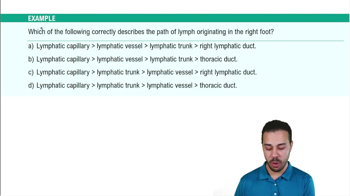
Lymphatic Vasculature Example 5
2545
views
48
rank
2:26
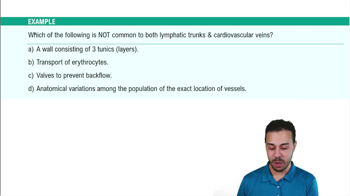
Lymphatic Vasculature Example 4
2833
views
62
rank
2:25
Lymphatic Vasculature Example 2
2933
views
49
rank
Terms in this set (15)
Hide definitions
Lymphatic Capillaries
Smallest and most numerous vessels, absorb interstitial fluid and proteins, initiating lymph formation.
Lymphatic Vessels
Larger than capillaries, contain valves to prevent backflow, transport lymph towards trunks and ducts.
Lymphatic Trunks
Collect lymph from vessels, named for body regions they drain, merge to form lymphatic ducts.
Lymphatic Ducts
Largest lymphatic vessels, empty lymph into veins near the heart, include right and thoracic ducts.
Valves
Structures in lymphatic vessels preventing backflow, ensuring one-way lymph movement.
Lymph Nodes
Bean-shaped structures in lymphatic vasculature, play a role in immune response by filtering lymph.
Skeletal Muscle Contractions
Voluntary muscle movements compress lymphatic vessels, aiding lymph propulsion.
Smooth Muscle Contractions
Involuntary muscle contractions in vessel walls, help propel lymph through larger vessels.
Arterial Pulsations
Rhythmic artery movements compress nearby lymphatic vessels, aiding lymph flow.
Respiratory Movements
Breathing changes abdominal pressure, aiding lymph propulsion through vessels.
Interstitial Fluid
Fluid absorbed by lymphatic capillaries, forming lymph.
Cisterna Chyli
Sac in the abdomen storing lymph, origin of the thoracic duct.
Endothelial Cells
Cells forming lymphatic capillary walls, create one-way flaps for fluid entry.
Anchoring Proteins
Structures maintaining lymphatic capillary position during valve operation.
Fluid Balance
Lymphatic system function, returning leaked fluids to cardiovascular system.
 BackBack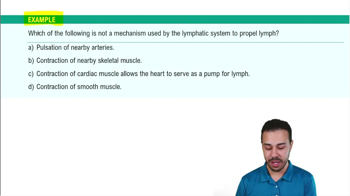
 2:02
2:02