Skip to main content
Anatomy & Physiology
My Course
Learn
Exam Prep
AI Tutor
Study Guides
Textbook Solutions
Flashcards
Explore
Try the app
My Course
Learn
Exam Prep
AI Tutor
Study Guides
Textbook Solutions
Flashcards
Explore
Try the app
Back
Membrane Bound Receptors and Secondary Messengers definitions
3 students found this helpful
You can tap to flip the card.
GPCR
You can tap to flip the card.
👆
GPCR
A class of membrane-bound receptors that initiate signaling cascades, crucial for hormone signaling and other sensory functions.
Track progress
Control buttons has been changed to "navigation" mode.
1/15
Related flashcards
Related practice
Recommended videos
Membrane Bound Receptors and Secondary Messengers quiz
Membrane Bound Receptors and Secondary Messengers
25 Terms
Membrane Bound Receptors and Secondary Messengers quiz #1
Membrane Bound Receptors and Secondary Messengers
11 Terms
Membrane Bound Receptors and Secondary Messengers
16. The Endocrine System
3 problems
Topic
Intracellular Receptors and Direct Gene Action
16. The Endocrine System
Topic
16. The Endocrine System
5 topics
9 problems
Chapter
Bruce
Guided course
10:41
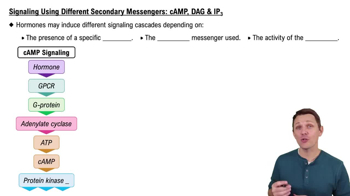
Secondary Messengers
5493
views
116
rank
Guided course
8:38
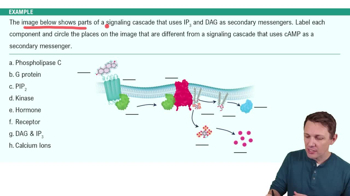
Membrane Bound Receptors and Secondary Messengers Example 3
4391
views
97
rank
Guided course
4:04
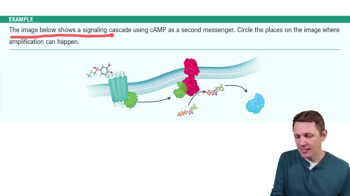
Membrane Bound Receptors and Secondary Messengers Example 2
4996
views
111
rank
Terms in this set (15)
Hide definitions
GPCR
A class of membrane-bound receptors that initiate signaling cascades, crucial for hormone signaling and other sensory functions.
Signaling Cascade
A series of linked chemical messengers that amplify a signal, similar to a waterfall gaining momentum.
Cyclic AMP
A secondary messenger produced from ATP by adenylate cyclase, crucial for activating protein kinase A.
Adenylate Cyclase
An enzyme that converts ATP to cyclic AMP, playing a key role in the cyclic AMP signaling cascade.
Protein Kinase A
An enzyme activated by cyclic AMP that phosphorylates proteins, triggering cellular responses.
Amplification
The process where a signal is increased in magnitude as it passes through a signaling cascade.
Secondary Messenger
Molecules like cyclic AMP, DAG, and IP3 that relay signals inside the cell, leading to various responses.
DAG
A secondary messenger produced by phospholipase C, involved in activating protein kinase C.
IP3
A secondary messenger that releases calcium ions from cellular stores, influencing various cellular activities.
Vasodilation
The widening of blood vessels, often triggered by cyclic AMP signaling in response to hormones like epinephrine.
Vasoconstriction
The narrowing of blood vessels, which can be induced by different signaling pathways in response to hormones.
G Protein
A protein activated by GPCRs that transmits signals to enzymes like adenylate cyclase in signaling pathways.
Phosphorylation
The addition of a phosphate group to a protein by kinases, altering the protein's function and activity.
Hormone
A signaling molecule that binds to specific receptors to induce changes in target cells.
Receptor
A protein on the cell surface or inside the cell that binds to specific molecules, initiating a cellular response.
 BackBack
 10:41
10:41